Japanese skincare has a reputation for being gentle, and for once the reputation is mostly deserved. The tradition grew around a simple idea: protect the skin you have instead of constantly trying to correct it. For anyone with sensitive, reactive or rosacea-prone skin, that idea is more useful than any single product.
This guide is the practical companion to our piece on Japanese skincare as a daily ritual. Here we focus on the principles behind Japanese skincare, how they compare with the Korean approach for reactive skin, which kinds of Japanese-style products are actually worth buying, and what sensitive skin should still watch for, because "made in the Japanese style" is not the same as "safe for every skin."
What are the core principles of Japanese skincare?
Strip away the packaging and the brand names, and Japanese skincare comes down to five habits:
- Gentle cleansing. Clean skin, never squeaky skin. Mild cleansers, lukewarm water, no scrubbing. Removing makeup and sunscreen thoroughly matters, but stripping the skin's natural oils does not help anyone.
- Layered hydration. Instead of one heavy cream, water is added in thin layers: a hydrating lotion or essence, then a light emulsion or moisturizer. Thin layers absorb better and are easier for reactive skin to tolerate.
- Prevention over correction. Daily sunscreen is not optional, and the goal is to avoid damage rather than repair it later with strong actives.
- Few products, used for a long time. A routine stays the same for months. Skin is given time to adapt instead of being asked to react to something new every week.
- Attention, not force. Products are pressed into the skin with the palms, not rubbed. It sounds minor; for skin that flushes at friction, it is not.
None of these principles requires a specific brand, or even a product made in Japan. They are a way of using products, and that is good news: you can apply them with what you already own.
Why Japanese skincare suits sensitive skin
Sensitive skin usually gets worse from too much, not too little: too many steps, too many actives, too much exfoliation, too many product changes. Each of the five habits above removes one of those stressors.
- Fewer steps means fewer ingredients that could trigger a reaction, and an easier time finding the culprit if one does.
- Hydration first supports the skin barrier, which is what keeps irritants out. If your barrier is already compromised, our guide on how to repair a damaged skin barrier covers the full reset.
- Daily sun protection removes one of the most common triggers of redness and flushing.
- Consistency gives the skin the four to six weeks it needs to settle, instead of restarting the clock every few days.
Our founder, Dr. Urbani, is a physician who lives with rosacea. She built IKI around exactly these habits because they are what her own skin tolerated: a short routine, gentle formulas, and patience.
What is better, Korean or Japanese skin care?
Neither is better in general; they solve different problems. Korean skincare (K-beauty) is known for innovation, playful textures and multi-step routines that often include several actives, sheet masks and frequent new launches. Japanese skincare (J-beauty) tends to be more conservative: fewer steps, refined textures, a strong focus on sunscreen and on long-term consistency.
For sensitive skin, the Japanese approach usually has the edge, for one reason: it asks you to use less. That said, many Korean products are excellent for reactive skin, especially the Centella asiatica (cica) and barrier lines. The smart move is to borrow the Japanese structure (short routine, daily sunscreen, no harsh exfoliation) and pick individual products from anywhere based on their ingredient lists. We compare the two routines step by step in our Japanese skincare ritual guide.
What Japanese skincare products are worth buying?
Think in categories rather than viral names. These four cover a complete Japanese-style routine:
1. A gentle cleanser
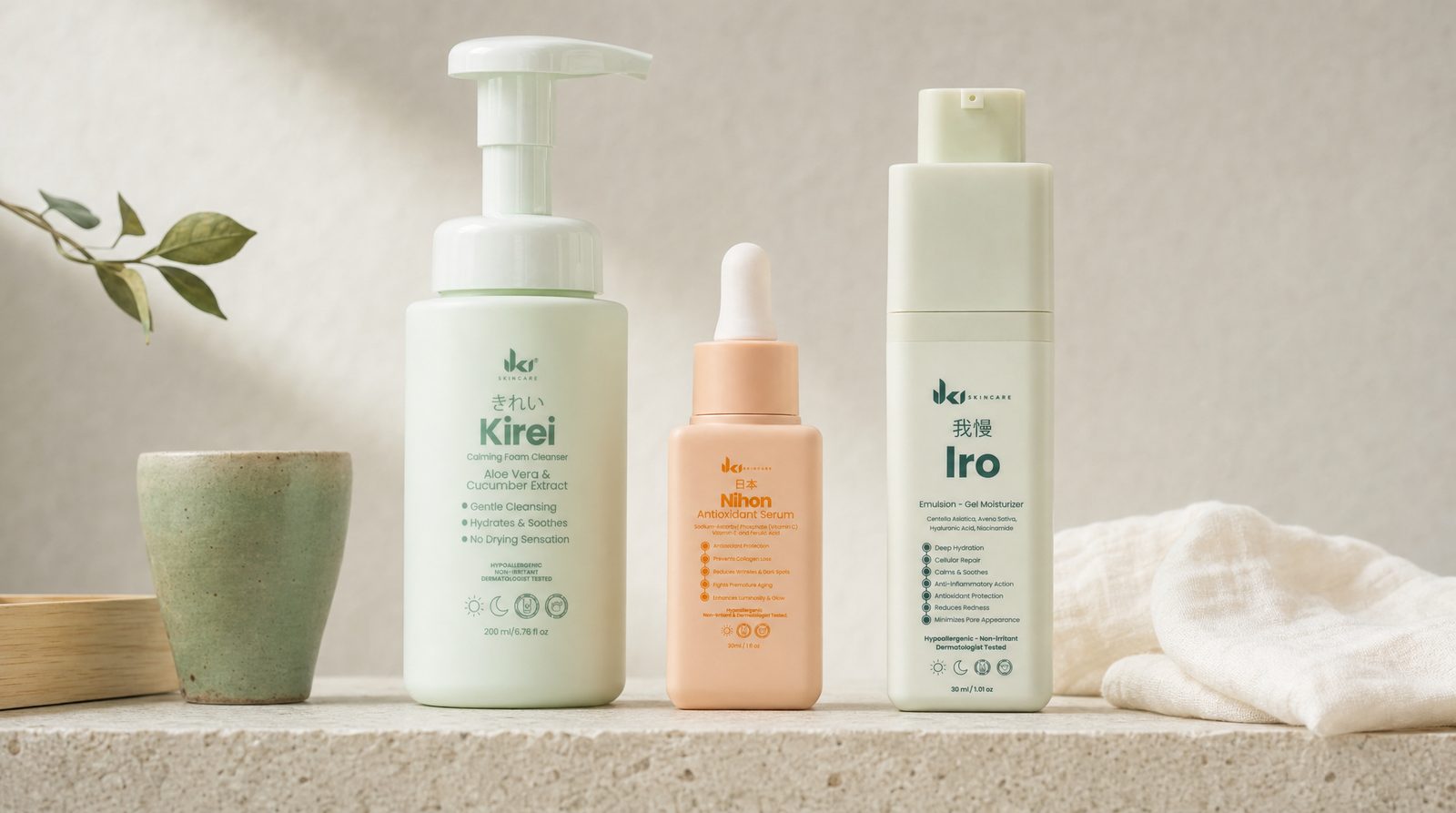
Japanese routines are famous for double cleansing: an oil or balm to dissolve sunscreen and makeup, then a mild foam. If you wear heavy makeup or water-resistant sunscreen, an oil cleanser first can be worth it. If you do not, a single gentle cleanser at night is enough for sensitive skin, and a rinse with water in the morning is often all you need. Look for sulfate-free formulas with a skin-friendly pH. Our Kirei Calming Foam Cleanser is sulfate-free and pH-balanced at around 5.5; in its 30-day study, 92% of 48 participants said it did not cause irritation, and a dermatologist-supervised 48-hour patch test on 27 participants showed no reaction.
2. A hydrating lotion, essence or serum
In Japan, "lotion" usually means a watery hydrating layer applied after cleansing, not a body lotion. Its job is to add water and prepare the skin for what comes next. A gentle antioxidant serum can play the same role in the morning. Nihon Antioxidant Serum uses sodium ascorbyl phosphate, a gentle form of vitamin C, with vitamin E and ferulic acid, and it is fragrance-free. In its 30-day study, 100% of the 45 participants who completed it said it feels gentle on the skin.
3. A light moisturizer or emulsion
Japanese moisturizers are often lighter than Western creams: milky emulsions and gels that seal in hydration without heaviness. For sensitive skin, look for barrier-supporting ingredients such as niacinamide, colloidal oatmeal, Centella asiatica, squalane and hyaluronic acid. Iro Emulsion Gel Moisturizer combines all five in a weightless gel. In its 30-day study, 100% of 49 participants said it feels gentle and 96% said their skin feels more hydrated.
4. A daily sunscreen
Japanese sunscreens are widely loved for their light, invisible textures, and they are often what travelers bring home first. One caution for sensitive skin: many popular Japanese sunscreens contain alcohol (listed as "alcohol" or "alcohol denat.") near the top of the ingredient list, which helps them feel weightless but can sting reactive skin. If that happens to you, look for alcohol-free versions or a mineral sunscreen with zinc oxide.
Put together, Kirei, Nihon and Iro make a three-step Japanese-style morning routine, followed by your sunscreen. You can find them together as our morning routine.
What is the best Japanese skincare brand?
There is no honest single answer, and any list that claims one is ranking by popularity, not by your skin. Japan has excellent skincare at every price point, from pharmacy basics to luxury lines, and the right one depends on your skin type, budget and what your skin reacts to.
A better question is how to judge any Japanese or Japanese-inspired brand. Ask four things:
- Does it publish the full ingredient list? If you cannot see it, you cannot check it.
- Is it gentle by design? No harsh sulfates, no high alcohol in leave-on products, no strong exfoliants in daily steps.
- Is it honest about fragrance? Many Japanese products are lightly scented. If your skin reacts to fragrance, check every label; our guide to fragrance-free vs unscented explains what to look for.
- Does it show evidence? Testing on real people, with the numbers published, says more than a heritage story.
We hold ourselves to the same test. IKI is inspired by Japanese skincare principles and built for sensitive skin, and we say plainly what is in each bottle: Kirei and Iro have no added fragrance but contain a trace of lemon oil, which gives them a light natural scent, while Nihon is fragrance-free. Across six independent 30-day studies with 277 participants, no allergic or severe adverse reactions were reported, and every result is on our study results page.
What sensitive skin should still avoid, even in Japanese skincare
A Japanese label is not a guarantee. Watch for:
- Alcohol high on the list in toners, lotions and sunscreens, if it stings.
- Fragrance and essential oils, which are common in some Japanese and Japanese-style lines.
- Exfoliating powders and peeling gels. Enzyme washes and "peeling" gels are popular, but daily exfoliation is hard on reactive skin. Once a week at most, and only when skin is calm.
- Too many new products at once. Even the gentlest routine should be introduced one product at a time, a week or two apart, so you know what works.
How to start a Japanese-style routine for sensitive skin
- Morning: rinse or gentle cleanse, antioxidant serum, light moisturizer, sunscreen.
- Night: gentle cleanse (with an oil first only if you wore heavy sunscreen or makeup), then moisturizer.
- Press, do not rub. Warm each product between your palms and press it in.
- Keep it for six weeks before judging, and change one thing at a time.
That is the whole method. It is not exotic and it is not fast, which is exactly why it works for skin that has had enough of being fixed.