Dark spots are one of the most common reasons people start a skincare routine, and one of the most common reasons sensitive skin ends up irritated. Strong peels, high-strength acids and bleaching creams can fade pigment, but on reactive skin they often trigger the very inflammation that creates new spots.
There is a gentler route. Alpha arbutin and kojic acid are two of the best-studied brighteners after hydroquinone, and both work by quietly slowing pigment production instead of stripping the skin. This guide explains what each one does, what to expect, and a simple plan you can follow for the 12 weeks pigment actually needs.
Why dark spots form, and why they come back
Skin color comes from melanin, made by cells called melanocytes. The key step is controlled by one enzyme, tyrosinase. When something triggers those cells, they make more melanin in one area, and a spot appears. The three common types:
- Sun spots (solar lentigines): flat brown spots on the face and hands after years of sun exposure.
- Post-inflammatory hyperpigmentation: marks left behind by a breakout, a scratch, a burn, or irritation from a product that was too strong.
- Melasma: larger, symmetrical patches, often on the cheeks, forehead and upper lip, linked to hormones, sun, visible light and heat. It is the most stubborn of the three, and worth discussing with a doctor.
Two things are true for all three. Pigment fades slowly, because the darkened cells have to be shed as the skin renews. And without sun protection, new pigment forms faster than any serum can fade it. That is why so many dark spot routines seem to "stop working."
What does alpha arbutin serum do?
Alpha arbutin is a molecule made of hydroquinone bound to a sugar. It inhibits tyrosinase, so less pigment is produced. Because the hydroquinone stays bound, it does not behave like free hydroquinone: it does not bleach, does not thin the skin, and irritation is rare.
- Evidence: clinical work on melasma and post-inflammatory marks shows measurable lightening at 1% to 2% over 8 to 12 weeks, with very low irritation. In the EU, its maximum in face products is 2%.
- Best for: sensitive skin, melasma-prone skin, and anyone who wants a brightener they can use every night.
Read the full profile in our alpha arbutin ingredient guide.
What is kojic acid serum good for?
Kojic acid is made by koji, the fermentation mold behind sake, miso and soy sauce, and it has been used in Japanese skincare since the 1980s. It slows pigment in two ways: it inhibits tyrosinase directly, and it binds the copper the enzyme needs to work. It also has mild antioxidant activity.
The catch is the form. Pure kojic acid is unstable, turns brown as it oxidizes, and can sting or sensitize, especially at higher concentrations. Kojic acid dipalmitate is kojic acid bonded to two fatty acid chains: stable, oil-soluble and gentler on contact. For sensitive skin it is the form to look for on the label. More in our kojic acid ingredient guide.
Why alpha arbutin and kojic acid work better together
Pigment is made in a chain of steps, and each brightener acts on a different link. Combining gentle ingredients at moderate levels tends to work better, and irritate less, than pushing one ingredient to a high strength.
- Alpha arbutin and kojic acid both slow tyrosinase, by slightly different mechanisms.
- Niacinamide slows the transfer of pigment from melanocytes to the surrounding skin cells.
- Vitamin C helps reduce existing pigment and protects against the oxidative damage that triggers new pigment.
- Retinoids speed up the shedding of pigmented cells, so spots fade faster.
- Sunscreen stops the main trigger. Without it, nothing else matters much.
If you must pick only one for very reactive skin, alpha arbutin is the gentler of the two.
Do dark spot serums actually work?
Yes, if your expectations match how pigment behaves. A good brightening serum will not erase a spot in a week, and anything that claims to is either exaggerating or too harsh for sensitive skin. Realistically:
- Weeks 1 to 4: skin often looks brighter and more even overall. Spots themselves change little.
- Weeks 4 to 8: first visible fading of newer marks, especially post-breakout marks.
- Weeks 8 to 12: clearer results on sun spots. Melasma improves more slowly and needs strict, ongoing sun protection.
Stopping early is the most common reason a brightener "did not work." Deep, long-standing spots and melasma may also need in-office treatment; a doctor can tell you which kind of pigment you are dealing with.
Does kojic acid lighten your skin tone?
No. Kojic acid and alpha arbutin reduce excess pigment in spots and patches. With normal use they do not bleach or change your natural, baseline skin tone. Be wary of any product sold as "skin whitening": that framing usually goes with high concentrations, harsh ingredients or, in some unregulated products, ingredients that should not be on the skin at all.
It is also worth knowing why these gentler options matter. Hydroquinone, the classic prescription brightener, has not been sold over the counter in the US since 2020, and it is not a good fit for long-term use on sensitive skin. Arbutin and kojic acid are the ingredients most people can use safely for months.
What should you not mix with alpha arbutin?
Alpha arbutin is easy to combine. It layers well with niacinamide, hyaluronic acid, Centella and vitamin C. The cautions are about the routine as a whole:
- Several strong actives at once. A brightening serum, a strong exfoliating acid and a new retinoid in the same week is how sensitive skin ends up inflamed, and inflammation creates more pigment.
- High-strength peels on the same night. If you exfoliate, do it rarely and on a different night.
- Scrubs and hot water. Friction and heat both aggravate pigment, especially melasma.
Can I apply alpha arbutin or kojic acid daily?
Most people can. Alpha arbutin is gentle enough for daily use from the start. Kojic acid dipalmitate is also suitable for nightly use for most skin types. If the serum you choose also contains retinol, start with three nights a week and build up. If your skin is very reactive, patch test on the inner forearm for two days first.
A gentle 12-week plan for dark spots
Morning
- Cleanse gently, or just rinse with lukewarm water. Kirei is sulfate-free and pH-balanced.
- Vitamin C. A gentle, stable form such as the sodium ascorbyl phosphate in Nihon. Our guide to vitamin C for sensitive skin explains why that form suits reactive skin.
- Moisturizer. Iro adds niacinamide, which also helps with uneven tone.
- Broad-spectrum sunscreen, SPF 30 or higher, every day, reapplied when you are outdoors. For melasma, a tinted mineral sunscreen with iron oxides also helps block visible light.
Night
- Cleanse to remove sunscreen.
- Brightening serum with alpha arbutin and kojic acid.
- Moisturizer to keep the barrier steady.
Take a photo in the same light on day one, then again at weeks 4, 8 and 12. Pigment changes too slowly to judge in the mirror day to day.
What is the best serum for hyperpigmentation?
There is no single best one, but a good serum for sensitive skin has a few things in common: brighteners at sensible levels rather than maximum strength, gentle forms (alpha arbutin, kojic acid dipalmitate), calming ingredients alongside the actives, no added fragrance, and honest timelines. Be cautious with anything promising results in days.
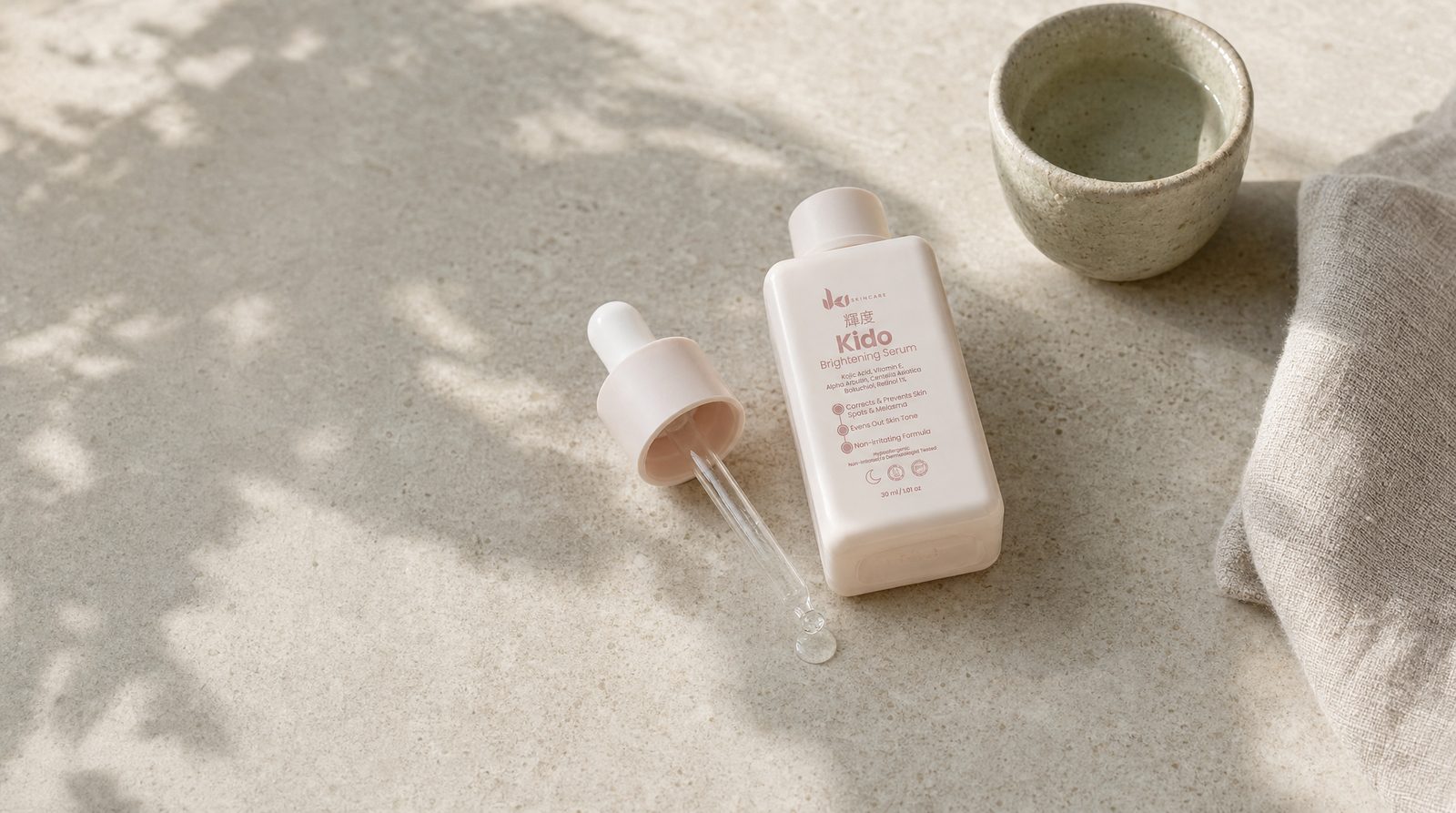
Our Kido Brightening Serum is built that way. It combines alpha arbutin and kojic acid dipalmitate with retinol to speed renewal, in a fragrance-free base with Centella asiatica, vitamin E and hyaluronic acid. In an independent 30-day perception study with 45 participants with sensitive skin, 89% said it is gentle on their skin, 87% said their skin has a more luminous glow and 73% said their skin tone appears more even, with no adverse events reported. Every question and answer is on our study results page.
Because it contains retinol, Kido is a night serum: start with three nights a week, wear sunscreen every morning, and do not use it during pregnancy or breastfeeding. If you need to avoid retinol, read our comparison of bakuchiol vs retinol for gentler renewal options.
The bottom line
Fading dark spots on sensitive skin is less about strength and more about consistency. Alpha arbutin and kojic acid slow pigment at its source, gently enough to use every night. Pair them with vitamin C in the morning, sunscreen every day, and twelve weeks of patience, and you give your skin the conditions it needs to even out without paying for it with irritation.