Most sensitive-skin routines go wrong at the first step. A moisturizer sits on your face for hours, so people choose it carefully. A cleanser is on for thirty seconds, so people grab whatever foams. But those thirty seconds happen once or twice a day, every day, and a harsh cleanser can undo everything the rest of the routine is trying to fix.
This guide will not hand you a single "winner." Sensitive skin is too individual for that. Instead it gives you the checklist dermatologists use, explains which ingredients matter and which do not, and compares four well-tolerated options honestly, including three that are not ours.
What makes a cleanser "gentle"?
Every cleanser works the same way: surfactants surround oil and dirt so water can rinse them away. The problem is that surfactants cannot tell the difference between the sebum and sunscreen you want gone and the lipids (ceramides, cholesterol, fatty acids) that hold your skin barrier together. A gentle cleanser is one that removes the first without taking too much of the second. Four things decide that:
- The surfactant type. Sodium lauryl sulfate (SLS) and sodium laureth sulfate (SLES) are effective and cheap, and they are also the classic lab irritants used to damage skin on purpose in studies. Milder options include cocamidopropyl betaine, cocamidopropyl hydroxysultaine, decyl or coco glucoside, and amino-acid surfactants such as sodium lauroyl sarcosinate or sodium cocoyl glycinate.
- The pH. Healthy skin sits at roughly 4.7 to 5.5. Traditional bar soap is around 9 to 10. A cleanser near 5.5 disturbs the acid mantle far less, which matters most when the barrier is already weak.
- What is left out. Added fragrance, high amounts of drying alcohol, and exfoliating acids all add irritation on top of the cleansing itself.
- What is put back. Glycerin, squalane, ceramides, niacinamide or panthenol help offset what cleansing removes. They are a bonus, not a requirement, because a cleanser is rinsed off within a minute.
What is the best cleanser for extremely sensitive skin?
For skin that reacts to almost everything, fewer ingredients beat better ingredients. Look for:
- No sulfates. Check the first five ingredients for "sodium lauryl sulfate" or "sodium laureth sulfate."
- No fragrance and no essential oils. On the INCI list, "parfum," "fragrance," and any "... oil" from citrus, lavender, peppermint or eucalyptus. Fragrance is the most common cause of allergic contact reactions to cosmetics.
- A short ingredient list. Fifteen ingredients or fewer is a good rule of thumb. Every ingredient you remove is one fewer thing to react to.
- No exfoliants in the cleanser. Salicylic acid, glycolic acid, beads and enzymes belong in a separate, optional step, not in something you use twice a day.
- A texture you can use without scrubbing. Cream, gel, milk or a soft foam all work. What matters is that you can rinse it off with lukewarm water and your fingertips.
If your skin is in an active flare (burning, peeling, stinging with water), consider a non-foaming cream or milk cleanser used only at night, with a plain water rinse in the morning. You can move back to a foam once the skin is calm. Our guide on how to repair a damaged skin barrier covers that reset in detail.
Foaming or non-foaming: which is better for sensitive skin?
Foam itself is not the problem. The idea that "foaming cleansers are harsh" comes from sulfate foams, which produce big, stiff lather and leave skin squeaky. A foam built on mild surfactants can be just as gentle as a lotion cleanser. The honest trade-off:
- Cream and lotion cleansers are the lowest-risk option for very dry or flaring skin. They can feel like they leave a film, and some people with oily skin feel they do not clean enough.
- Gentle foams and gels suit oily, combination and normal-sensitive skin, rinse cleaner, and are easier to use on a beard or around the hairline.
The test is the same for both: ten minutes after washing, your skin should feel comfortable and slightly soft. If it feels tight, the cleanser is too strong for you right now.
Which cleanser do dermatologists recommend?
Dermatologists rarely recommend a brand; they recommend a profile. The drugstore names that come up most often, CeraVe, La Roche-Posay and Vanicream, come up because they fit that profile and are easy to find, not because they contain anything special. Here is how four options compare on what actually matters. Ingredient details come from each brand's published INCI list at the time of writing; always check the current label.
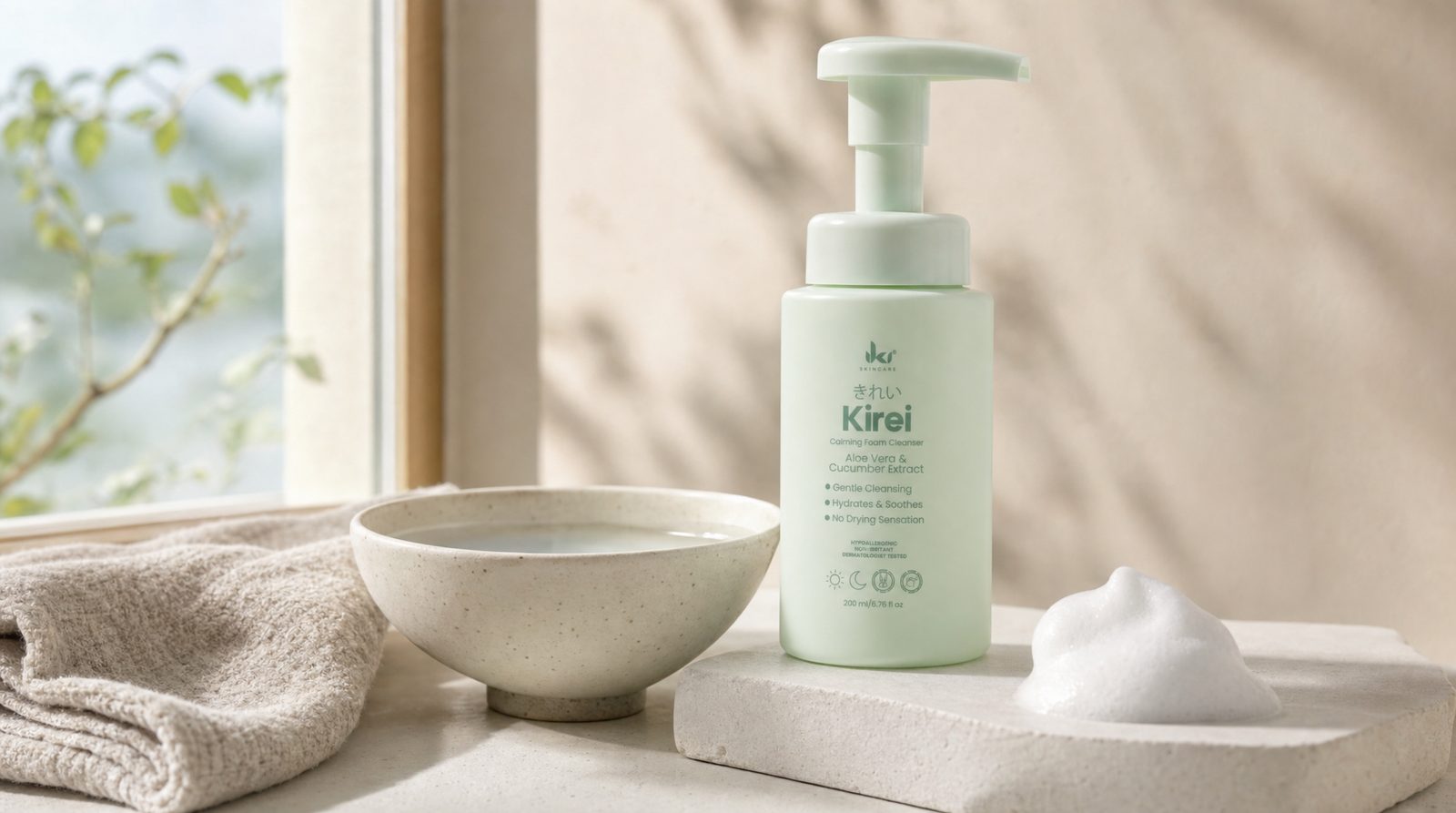
Kirei Calming Foam Cleanser (IKI)
Type: soft pump foam. Surfactants: cocamidopropyl betaine, decyl glucoside, cocamidopropyl hydroxysultaine, sodium lauroyl sarcosinate; no sulfates. pH: around 5.5. Also contains: glycerin, squalane, cucumber extract, aloe. Fragrance: no added fragrance, but it contains a small amount of lemon peel oil for a light natural scent.
Evidence: in an independent 30-day perception study (The Good Face Project, July 2025) with 48 people with sensitive skin, 92% said it did not cause irritation and 96% said the foam feels soft on their skin. A separate dermatologist-supervised 48-hour patch test by Evalulab on 27 participants showed no reaction.
Best for: sensitive, redness-prone, oily or combination skin that wants a real foam without tightness. Skip it if: you know you react to citrus oils; choose one of the fully fragrance-free options below instead. See the full Kirei ingredient list.
CeraVe Hydrating Facial Cleanser
Type: non-foaming lotion. Notable ingredients: ceramides, hyaluronic acid, glycerin. Fragrance: fragrance-free. Best for: dry, very dry or eczema-prone skin, and anyone in a flare. Trade-off: some people with oily skin find it does not feel clean enough, and it is not designed to remove heavy makeup on its own.
La Roche-Posay Toleriane Hydrating Gentle Cleanser
Type: cream-to-lotion. Notable ingredients: ceramide, niacinamide, glycerin, the brand's thermal spring water. Fragrance: fragrance-free. Best for: normal-to-dry sensitive skin. Trade-off: similar to CeraVe; a comfortable, low-lather texture that oily skin may find too rich.
Vanicream Gentle Facial Cleanser
Type: low-foam gel. Selling point: formulated without dyes, fragrance, parabens, formaldehyde releasers and other common allergens, with a deliberately minimal ingredient list. Best for: people with known contact allergies or skin that reacts to almost everything. Trade-off: no calming or hydrating extras by design; it only cleans.
The honest summary: if you have confirmed contact allergies or react to any botanical, start with Vanicream. If your skin is dry and flaring, CeraVe or La Roche-Posay are safe, inexpensive choices. If you have sensitive skin that is also oily or combination and you miss a real foam, Kirei was built for exactly that gap.
What is the best face wash for sensitive skin, morning and night?
Often the answer is: less face wash. A few practical rules matter as much as the product:
- Morning: if your skin is dry or reactive, a lukewarm water rinse is enough. If it is oily or you use a rich night cream, use a small amount of a gentle cleanser.
- Night: always cleanse, because sunscreen, pollution and sebum need to come off. If you wear water-resistant sunscreen or heavy makeup, dissolve it first with a cleansing oil or balm, then follow with your gentle cleanser. Two mild cleanses are kinder than one aggressive one.
- Water temperature: lukewarm, never hot. Hot water dissolves barrier lipids on its own.
- Technique: fingertips only, 30 to 60 seconds, no washcloths or brushes. Pat dry with a clean towel; do not rub.
- Next step within a minute: apply your moisturizer to slightly damp skin. In our routine that is Iro Emulsion Gel Moisturizer, which 100% of its 49 study participants said feels gentle.
Ingredients to avoid in a sensitive-skin cleanser
- Sodium lauryl sulfate and sodium laureth sulfate high on the list.
- Parfum or fragrance, and essential oils if you know you are reactive.
- Alcohol denat. or SD alcohol in the first few ingredients.
- Exfoliating acids and scrubs (salicylic, glycolic, walnut shell, beads) in a daily cleanser.
- Menthol, camphor and peppermint, which create a "tingle" that is really irritation.
Ingredients you do not need to fear: cocamidopropyl betaine and glucosides (mild surfactants), phenoxyethanol at normal levels (a well-tolerated preservative), and citric acid (used in tiny amounts to set the pH, not to exfoliate).
How to switch cleansers without a reaction
Even a well-chosen cleanser is a new product. Patch test it first: apply a small amount to the inner forearm or behind the ear, rinse as you normally would, and repeat once a day for three days. If there is no redness or itching, start using it on your face at night only for the first week. Change one product at a time, so that if something goes wrong you know exactly what caused it.
And give it time. A cleanser cannot repair a barrier on its own, but the wrong one can keep it damaged indefinitely. Most people notice the difference within two weeks of switching: less tightness, fewer red patches after washing, and moisturizers that stop stinging. For the rest of the routine, see our 3-step skincare routine for sensitive skin, and for every result from our 30-day studies, including the less flattering ones, visit the study results page.