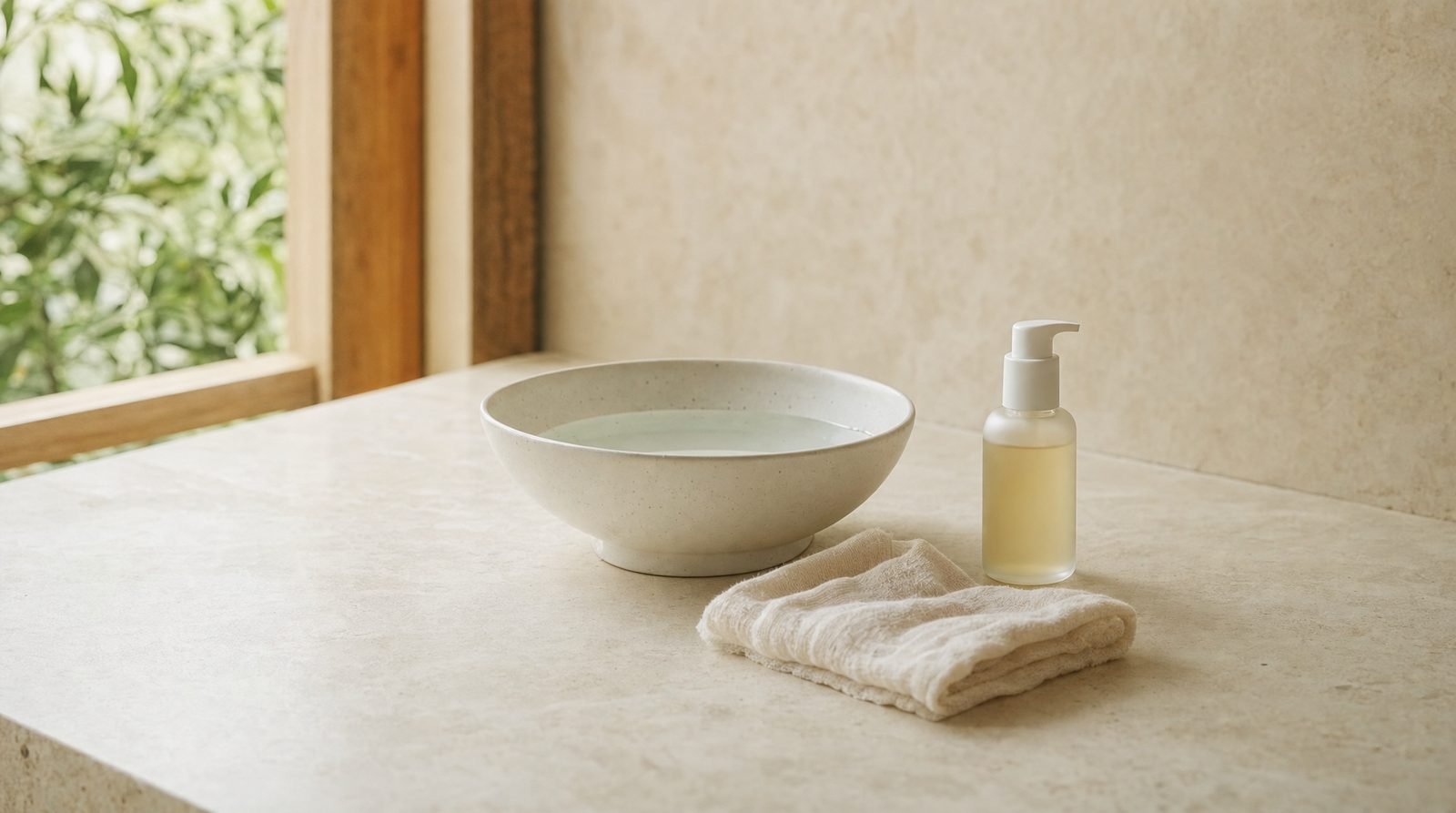
There is a moment, for most people with difficult skin, when the bathroom shelf becomes a graveyard. Half-used bottles. Serums bought on a promise. Creams that worked for a week and then didn't. The collection grows in the hope that somewhere inside it is the answer.
More has never been the answer. The most effective skincare routine is usually the one with the fewest steps. Three, to be exact: cleanse, hydrate, protect. That is the entire foundation. Everything else is a refinement layered on top, and refinements only work when the foundation is stable.
What are the basics of a skincare routine?
The skin is not waiting to be improved. It renews itself, defends itself and maintains its own balance every day. What it needs from us is support, not intervention. Three products provide it:
- A gentle cleanser removes what the day leaves behind without stripping what the skin needs.
- A moisturizer replaces the water that evaporates and reinforces the barrier that protects everything underneath.
- Sunscreen blocks the single biggest cause of premature aging, dark spots and sensitivity flare-ups.
Those three things, repeated consistently, do more than most ten-step routines ever will.
What the extra steps are really doing
Most products stacked on top of a basic routine are either duplicating what a good moisturizer already does, or introducing stress the skin did not need. Toners that strip. Essences that overlap. Multiple serums layered without a reason. Acids on Monday, retinol on Tuesday, a brightening mask on Wednesday. The skin never has time to settle between any of them.
When skin behaves badly, the instinct is to add something. Adding is usually what caused the behavior in the first place. If your skin is currently reacting, our guide to repairing a damaged skin barrier explains what to remove first.
How do I create a simple skincare routine?
A three-step routine is only as good as the three products inside it. This is where care matters.
The cleanser
pH-balanced (around 5.5), sulfate-free, with calming ingredients such as aloe vera or cucumber extract. It should leave skin feeling fresh, never tight. Use it once a day, at night; in the morning, water is enough. This is the brief Kirei Calming Foam Cleanser was formulated to.
The moisturizer
Humectants such as multi-weight hyaluronic acid, plus barrier-supporting ingredients such as niacinamide, Centella asiatica or colloidal oatmeal. It should absorb quickly and feel weightless, so you actually use it twice a day. Iro Emulsion Gel Moisturizer is that formula; 96% of participants in its 30-day study said their skin felt more moisturized.
The sunscreen
Broad-spectrum, SPF 30 or higher, reapplied when you are outdoors, and chosen for tolerance. Mineral filters (zinc oxide, titanium dioxide) suit sensitive skin best. IKI does not make a sunscreen; use one you tolerate and never skip it.
The discipline of subtraction
Removing products feels counterintuitive, especially if the skin is already reacting. It can feel like giving up. But subtraction is a practice. It takes trust in the skin's own intelligence. It means accepting that for a week or two the skin may look worse before it looks calmer, simply because it is adjusting to not being pushed.
After that adjustment, something happens. The redness softens. The tightness loosens. Flare-ups become less frequent. The skin, finally given space, starts to behave like itself again.
When (and how) to add a fourth step
Once the three steps have been stable for four to six weeks, you can add one targeted product, and only one at a time:
- Morning antioxidant: a gentle vitamin C such as sodium ascorbyl phosphate (Nihon), under sunscreen.
- Night renewal: copper peptides (Izumi) for firmness without retinol, or a brightening serum such as Kido for dark spots.
Wait two to three weeks before judging, and go back to three steps for a week if anything stings.
A gentler relationship with skincare
There is something quietly freeing about a simpler routine. The morning moves faster. The evening feels less like a checklist. The shelf empties. The mental space that skincare used to occupy returns to you. Skincare does not have to be a second job. It can be a brief, steady gesture, repeated twice a day, that asks very little and gives back quite a lot. The fewer steps you take, the more carefully you can take them.