Walk down any skincare aisle and you will find "cica" on creams, toners, sheet masks and even sunscreens. It is sold as the answer to red, irritated skin. Some of that reputation is earned and some of it is marketing, and if your skin flushes easily, it is worth knowing which is which.
This guide explains what Centella asiatica is, what its active compounds do, what it can realistically do for redness-prone skin, how it compares with niacinamide, and how to use it. For a shorter overview, see our Centella asiatica ingredient guide.
What is Centella asiatica (cica)?
Centella asiatica is a small, creeping herb with round, scalloped leaves that grows in damp ground across Asia and other tropical regions. It goes by several names: gotu kola, tiger grass, Indian pennywort and, in skincare, "cica," a short form popularized by Korean and Japanese beauty brands.
The plant has a long history in traditional medicine, and its extract has been studied in modern dermatology for decades, first for wound healing. On an ingredient list it usually appears as Centella Asiatica Extract or Centella Asiatica (Gotu Kola) Extract. Some products instead use one of its isolated compounds, such as madecassoside.
What does centella do for skin?
Centella's effects come from four main compounds, often called centelloids: madecassoside, asiaticoside, asiatic acid and madecassic acid. Research on them points to three useful jobs:
- Soothing. The compounds, madecassoside especially, have anti-inflammatory activity in laboratory and clinical research. On the skin, that translates into a calmer, more comfortable feel after irritation.
- Supporting barrier repair. Asiaticoside and asiatic acid support the cells that rebuild skin, which is the origin of centella's wound-healing reputation and why it shows up in post-procedure creams.
- Antioxidant protection. The extract helps neutralize free radicals from sun and pollution, one of the everyday stressors that leave reactive skin feeling irritated.
What centella does not do matters just as much. It is not an exfoliant, it does not lighten dark spots on its own, and it does not replace sunscreen. It is a support ingredient: it makes a routine more comfortable and works best next to other well-chosen ingredients.
Is centella good for redness and rosacea-prone skin?
It is one of the better choices, with an honest caveat. Redness has many causes: a damaged barrier from over-exfoliating, irritation from fragrance or harsh cleansers, sun and heat, and medical conditions such as rosacea or eczema.
- When redness comes from irritation or a weakened barrier, a gentle routine built around soothing ingredients like centella can help skin feel calmer as the barrier recovers. Our guide to repairing a damaged skin barrier covers the full approach.
- When redness comes from rosacea, centella is a well-tolerated ingredient for a supportive routine, but it does not treat the condition. Persistent flushing, visible vessels or bumps need a doctor's assessment and, often, prescription treatment.
Our founder, Dr. Urbani, is a physician who lives with rosacea, and her own rule is simple: skincare should never be part of the problem. That means short routines, gentle formulas and ingredients like centella that are known for being well tolerated. For a step-by-step plan, read gentle skincare for rosacea-prone skin.
Centella vs niacinamide: which is better for redness-prone skin?
They are not competitors. They do different jobs and work well together.
- Centella is primarily a soothing and repair ingredient. It is very gentle, rarely causes problems and suits skin that is irritated right now.
- Niacinamide (vitamin B3) supports the barrier from another angle: it helps skin produce its own ceramides and reduces water loss. It also helps with uneven tone and oil. At moderate levels it is well tolerated, but very high concentrations can sting reactive skin.
If your skin is easily irritated, a moisturizer that combines both, at moderate levels and alongside other calming ingredients such as colloidal oatmeal, is usually a better bet than a single high-strength serum of either. You can compare more options in our guide to ingredients that calm sensitive skin.
Can you use centella every day?
Yes. Centella is non-exfoliating and does not make skin more sensitive to the sun, so you can use it morning and night, under sunscreen and alongside most other ingredients, including vitamin C, retinoids and acids. Pairing it with stronger actives is one of its most useful roles: it helps keep a routine comfortable.
Where it sits in your routine depends on the product. In a serum, apply it after cleansing and before moisturizer. In a moisturizer, it is your last step at night and goes under sunscreen in the morning. As with anything new, give it four to six weeks of consistent use before judging it.
Who should be careful with centella?
Centella is one of the best-tolerated botanical ingredients, but no ingredient suits everyone.
- Plant allergies. Reactions are rare. People allergic to plants in the same family as carrots and celery (Apiaceae) should patch test first.
- The rest of the formula. A cica cream can still contain fragrance, essential oils or alcohol that irritate reactive skin. Check the whole ingredient list, not just the word "cica" on the front. Our guide to fragrance-free vs unscented explains what to look for.
- Pregnancy. Topical centella is generally considered low risk, but there are no controlled studies in pregnancy. Check with your doctor, and look at the other actives in the product too.
Patch test any new product on the inner forearm or behind the ear for a few days, and introduce one new product at a time.
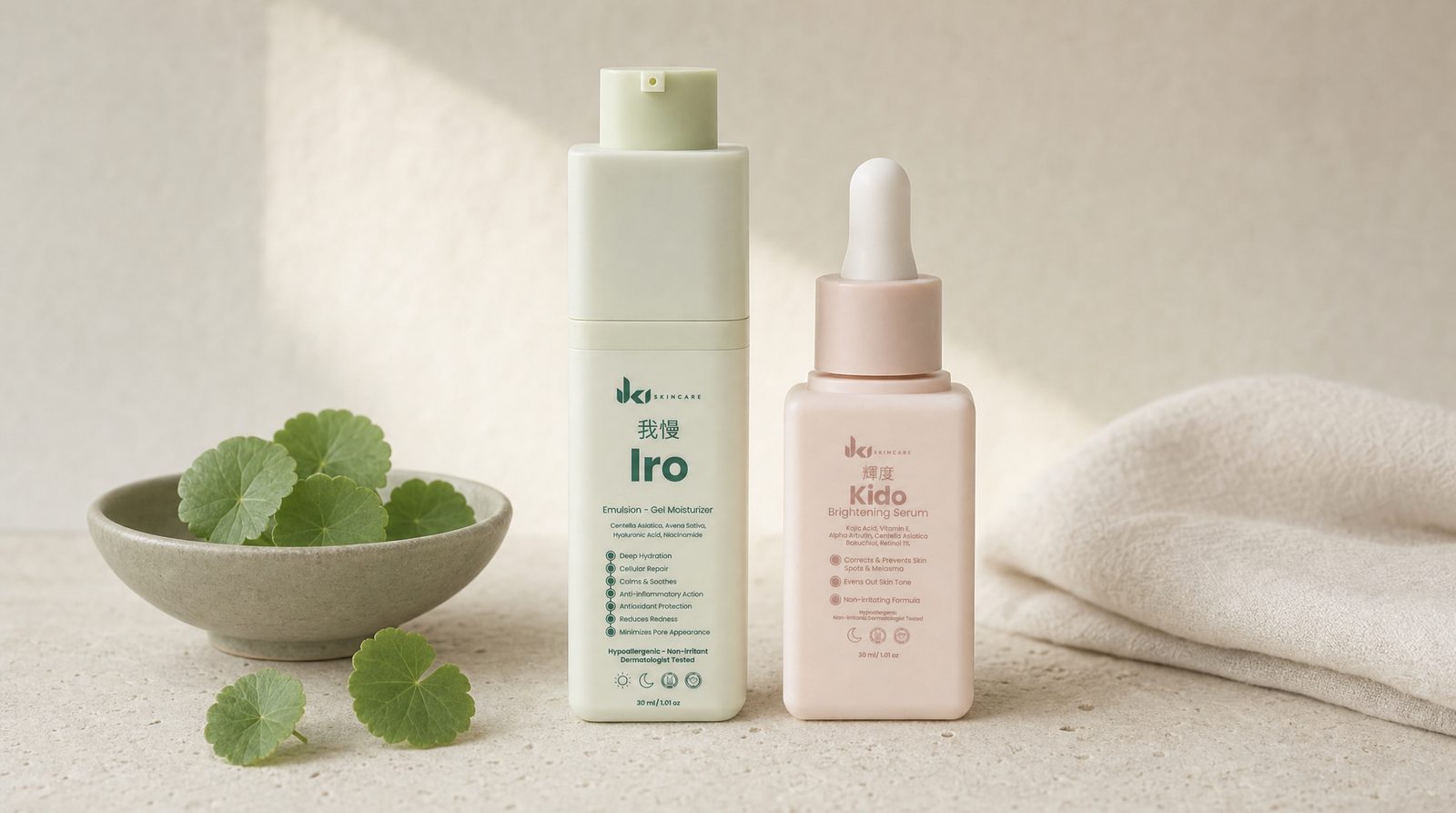
How IKI uses centella
We use Centella asiatica in two products, for two different reasons.
Iro Emulsion Gel Moisturizer: the everyday calming step
Iro combines Centella asiatica with niacinamide, colloidal oatmeal, squalane and several weights of hyaluronic acid in a weightless gel-emulsion that also suits oily and combination skin. It is hypoallergenic and dermatologist tested. In its independent 30-day study, 100% of the 49 participants said it feels gentle and 90% said their skin feels calmed and soothed. Iro has no added fragrance but contains a trace of lemon oil, so if citrus oils are a known trigger for you, patch test first.
Kido Brightening Serum: keeping a stronger formula comfortable
Kido pairs Centella with kojic acid and alpha arbutin for uneven tone. It also contains retinol, so it is a night-only serum, needs sunscreen every morning and is not for use during pregnancy. Centella's job here is to help keep the formula comfortable. In its 30-day study (45 participants), 89% said it feels gentle and 73% said their skin tone appears more even. Kido is fragrance-free and essential-oil-free.
Across six independent 30-day studies with 277 participants, no allergic or severe adverse reactions were reported. These are consumer perception studies, which measure what participants noticed; every statement and percentage is on our study results page.
The bottom line
Centella asiatica earns its place in skincare for redness-prone skin: it is gentle, well studied for a plant extract, and helps skin feel calmer and more comfortable while the barrier does its work. It is not a cure for redness, and it cannot fix a routine full of irritants. Use it in a well-formulated product, keep the rest of your routine simple, and see a doctor when redness does not settle.