You bought the "unscented" lotion because your skin reacts to perfume, and it still made your cheeks sting. That is not bad luck. In skincare labels, "unscented" and "fragrance-free" describe two different things, and neither one is a regulated promise.
This guide explains what each term actually means, why the difference matters for sensitive and reactive skin, how to check any product in about 30 seconds, and, because we think brands should show their own work, exactly where each IKI product stands.
What is the difference between fragrance-free and unscented?
The two terms answer different questions. Fragrance-free is about what goes in: no ingredient was added for the purpose of giving the product a smell or covering one. Unscented is about the result: the finished product should not smell of anything.
The catch is that raw skincare ingredients often do smell. Plant extracts, oils, sunscreen filters and some preservatives have their own odor, sometimes earthy, sometimes plastic, sometimes a little fishy. To make a product truly odorless, a manufacturer may add a small amount of a masking fragrance that neutralizes those notes. The product is then unscented, but it is not fragrance-free.
- Fragrance-free: nothing added for smell. It may still have a faint natural scent from its ingredients.
- Unscented: no noticeable smell. It may contain a masking fragrance to get there.
- "No added fragrance" or "no synthetic fragrance": usually means no perfume blend was added, but essential oils or plant oils with a scent may still be in the formula.
Are "fragrance-free" and "unscented" regulated?
In the United States, no. The FDA does not define either term for cosmetics, so a brand can print them without meeting a specific standard. A fragrance blend can also be listed as a single word, "fragrance" or "parfum," without naming the dozens of individual chemicals inside it.
The European Union goes further: certain fragrance allergens, such as limonene, linalool, citral and geraniol, must be named individually on the label when they are above set thresholds. That is why you may see those words at the end of a European ingredient list, even on products marketed as natural. Many of them come from essential oils.
The practical takeaway is simple: the front of the bottle is marketing, the ingredient list is the information.
Why does fragrance matter for sensitive skin?
Fragrance is one of the most common causes of allergic contact dermatitis from cosmetics, according to dermatology organizations such as the American Academy of Dermatology. Two different things can happen:
- Irritation: stinging, burning or redness that appears quickly, especially on skin with a weakened barrier. It depends on concentration and on the state of your skin that day.
- Allergy: once you are sensitized to a specific fragrance chemical, even small amounts can trigger an itchy, red rash, often a day or two after use. Allergy does not go away with time.
Not everyone reacts to fragrance, and plenty of people use perfumed products for years without a problem. But if your skin is reactive, rosacea-prone, eczema-prone or recovering from a damaged barrier, removing fragrance is one of the simplest ways to lower the number of things that can go wrong.
Are essential oils considered fragrance?
Functionally, yes. Essential oils such as lavender, lemon, orange, peppermint, tea tree and ylang-ylang are concentrated plant extracts made largely of the same aromatic compounds found in perfumes, including limonene and linalool. Your skin does not care whether those molecules came from a lab or a lemon peel.
That does not make essential oils automatically bad. In small amounts many people tolerate them well, and some have useful properties. It does mean a product with essential oils is not fragrance-free in the sense that matters for allergy-prone skin, even if the label says "no synthetic fragrance." Citrus oils deserve a specific mention: their limonene can oxidize with air and light into compounds that are more likely to sensitize skin.
How to check any product in 30 seconds
- Ignore the front label. "Clean," "natural," "gentle" and "unscented" tell you nothing about fragrance content.
- Find the full ingredient list (INCI). On the box, the bottle or the brand's product page. If a brand will not show it, that is an answer in itself.
- Search for these words: fragrance, parfum, aroma, perfume, flavor.
- Search for essential oils: usually written as the Latin plant name followed by "oil," for example Citrus Medica Limonum (Lemon) Peel Oil, Lavandula Angustifolia (Lavender) Oil or Citrus Sinensis (Orange) Oil.
- Check the end of the list for allergen names: limonene, linalool, citral, geraniol, citronellol, eugenol, coumarin. They usually point to fragrance or essential oils.
- Note where it sits. Ingredients are listed roughly from highest to lowest concentration; an oil near the end is a trace, near the top it is a major component. Both count if you are allergic.
If you have a known fragrance allergy, a dermatologist can patch test you to identify the exact chemicals, which makes label reading much easier.
What is a good fragrance-free moisturizer for sensitive skin?
Beyond being fragrance-free, a good moisturizer for very sensitive skin keeps the formula focused. Look for:
- Barrier-supporting ingredients such as niacinamide, colloidal oatmeal, Centella asiatica, squalane, ceramides and hyaluronic acid.
- No drying alcohol (alcohol denat. high on the list) and no exfoliating acids in a daily moisturizer.
- A texture you will actually use twice a day. Gel-emulsions for oily or combination skin, richer creams for dry skin.
- Short ingredient lists help, but are not required. What matters is whether the known irritants are absent.
Patch test anything new on the inner forearm or behind the ear for a few days before using it on your face, and introduce one new product at a time so you know what caused a reaction if one happens.
Where IKI stands, product by product
We formulate for sensitive skin, so we would rather tell you exactly what is in each bottle than lean on a vague label. Here is the honest breakdown, using the strict definition from this article.
Fragrance-free and essential-oil-free
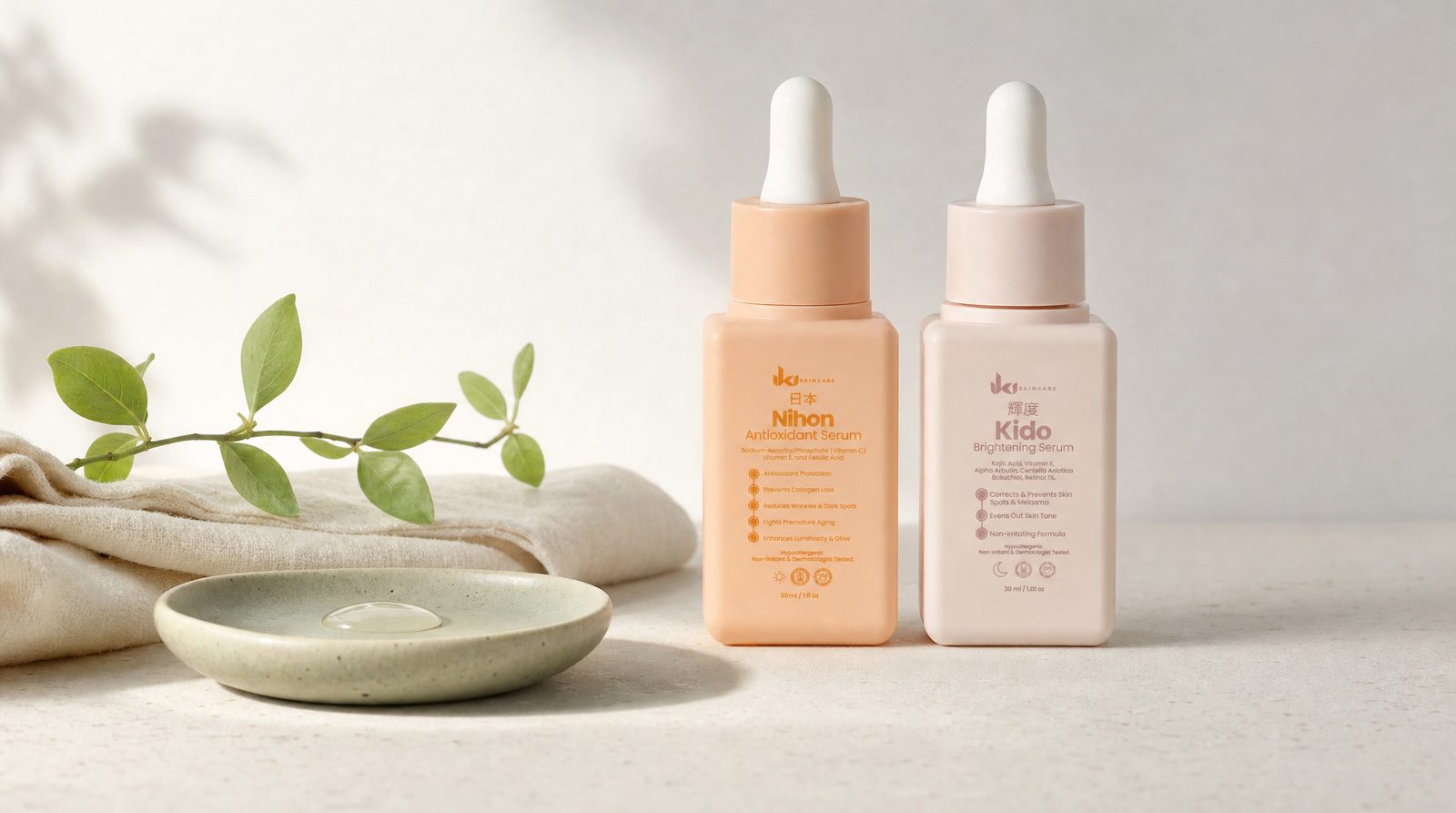
- Nihon Antioxidant Serum: fragrance-free. A gentle vitamin C derivative, sodium ascorbyl phosphate, with vitamin E and ferulic acid. In its 30-day study, 100% of the 45 participants who completed it said it feels gentle on the skin.
- Izumi Skin Regenerating Serum: fragrance-free and essential-oil-free, with copper peptides, niacinamide and resveratrol. In its 30-day study (46 participants), 93% said it feels gentle.
- Kido Brightening Serum: fragrance-free and essential-oil-free, with kojic acid, alpha arbutin and Centella. It also contains retinol, so it is a night-only product, needs sunscreen in the morning, and is not for use during pregnancy. In its 30-day study (45 participants), 89% said it feels gentle.
No added fragrance, with a trace of lemon oil
- Kirei Calming Foam Cleanser: no perfume blend is added, but the formula contains a small amount of Citrus Medica Limonum (Lemon) Peel Oil, which gives it a light, natural scent. By the strict definition, that means it is not fragrance-free. In its 30-day study, 92% of 48 participants said it did not cause irritation, and a separate dermatologist-supervised 48-hour patch test on 27 participants showed no reaction. If you know you react to citrus oils, patch test first.
- Iro Emulsion Gel Moisturizer: no perfume blend is added, but it contains a trace of Citrus Medica Limonum (Lemon) Oil. In its 30-day study, 100% of 49 participants said it feels gentle and 90% said their skin feels calmed and soothed. Same advice: if citrus oils are a known trigger for you, patch test first.
Naturally scented
- Gaman Body Repair Balm: a waterless body balm scented with lavender, manuka and sweet orange essential oils. It is not fragrance-free, and it is not vegan (it contains beeswax and emu oil). If you are sensitive to essential oils, it is not the right product for you.
Across six independent 30-day studies with 277 participants, no allergic or severe adverse reactions were reported. You can read every statement and every percentage, including the less flattering ones, on our study results page. If you need a routine with no fragrance and no essential oils at all, Nihon in the morning and Izumi or Kido at night, under a fragrance-free moisturizer and sunscreen of your choice, gets you there.
Does fragrance-free mean no smell?
No. A fragrance-free product can still have a faint scent from its ingredients: a slightly nutty note from oils, a grassy note from plant extracts, a mild "clinical" smell from some actives. That smell is not a sign of added perfume. If anything, a product that smells of absolutely nothing while being full of plant extracts is worth a second look at the ingredient list.
The bottom line
"Unscented" describes a smell; "fragrance-free" describes a formula; and neither is a guarantee on its own. If your skin is reactive, read the ingredient list, treat essential oils as fragrance, and introduce new products one at a time. And expect brands to tell you plainly what is in the bottle. That is the standard we try to hold ourselves to.