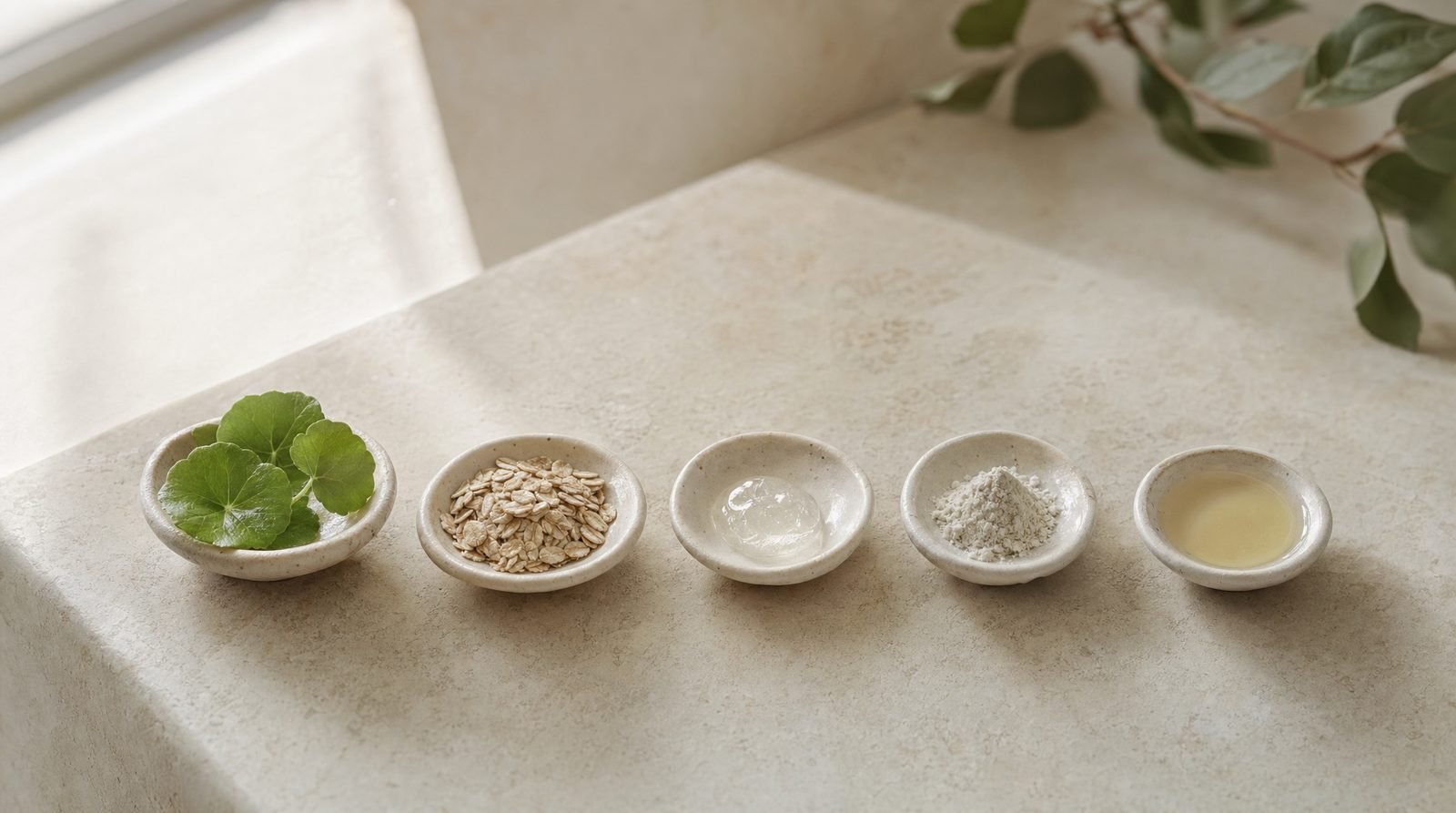
When your skin reacts to most things, the ingredient list becomes the most important part of any product. Not the marketing. Not the packaging. Not the promise on the front. The actual list, in small type, on the back.
This is a short, honest guide to the ingredients that calm sensitive skin, the ones that have earned their reputation through research and consistency. None of them are miracles. All of them work, slowly, without asking anything of the skin. Each has its own longer guide in our ingredient library.
The calming ingredients, and the evidence behind each
Centella asiatica (cica)
One of the most studied botanicals in dermatology, used in Asian medicine for centuries and in wound care since the 1950s. Its actives (madecassoside, asiaticoside) calm inflammation, reduce lingering redness and support repair. It does not exfoliate or resurface; it helps the skin recover from whatever it has been subjected to. For reactive skin it is often the first ingredient to introduce. Read the Centella guide.
Colloidal oatmeal (Avena sativa)
One of the very few skincare ingredients with regulatory status as a skin protectant. Its avenanthramides reduce itch and visible redness without numbing the skin or masking a reaction, and its beta-glucans hold water. Oats on irritated skin is not a trend; it is a recognition of what already worked. Read the oat guide.
Hyaluronic acid
Often described as a moisturizer, it is actually a humectant: a molecule that holds water against the skin. Most flare-ups are made worse by dehydration, even when skin looks oily. The form matters: low molecular weights reach deeper, high weights stay at the surface, and well-formulated products use several. Apply to damp skin and seal with a moisturizer.
Niacinamide (vitamin B3)
One of the rare ingredients that strengthens the skin barrier without irritating it. It supports ceramide production, softens redness, refines pores and improves tone over time, at 2% to 5%. It does not push the skin forward; it reinforces what is already there.
Ceramides and squalane
Ceramides are a structural component of the barrier itself; when the barrier weakens, they are often what is missing. Squalane is a skin-identical lipid that does the same job in a lighter form. Replacing them topically is a direct response to what the skin has lost.
Gentle actives: bakuchiol, copper peptides, stabilized vitamin C, alpha arbutin
Renewal and brightening do not have to mean irritation. Bakuchiol matched retinol on wrinkles and pigmentation in a 12-week trial with far less scaling. Copper peptides signal repair without forcing turnover. Sodium ascorbyl phosphate gives vitamin C's antioxidant benefit at a skin-friendly pH. Alpha arbutin and kojic acid dipalmitate fade dark spots without hydroquinone. If vitamin C or retinol ever stung, it was probably the form, not the ingredient.
Skincare ingredients to avoid with sensitive skin
Not every popular ingredient is a good idea for reactive skin. Five to be careful with:
- Synthetic fragrance ("parfum", "fragrance"). The most common contact allergen in cosmetics. If the list has it and you cannot see the rest, skip the product.
- Denatured alcohol high on the list. Used as a penetration enhancer and for a "fast-absorbing" feel; strips the barrier over time.
- High-strength AHAs and BHAs. Gentle exfoliation can be useful, but most formulas are stronger than sensitive skin can handle. Once a week with a PHA or low-strength lactic acid is plenty.
- Physical scrubs. The damage from hard particles is cumulative and invisible until the barrier fails.
- Essential oils in high concentration. Natural does not mean non-irritating; lavender, citrus and mint oils are frequent triggers. A trace for scent is usually fine; a "botanical blend" high on the list is not.
What "fragrance-free" really means
"Fragrance-free" means no fragrance ingredients were added. "Unscented" often means a masking fragrance was added to hide the smell of the formula, which is worse for reactive skin. And "fragrance-free" products can still contain essential oils or plant extracts that smell. The only way to know is the INCI list. At IKI, Izumi and Kido contain no scent ingredients at all; Kirei and Iro contain a trace of lemon oil; Gaman is scented only with lavender, manuka and orange essential oils. We list all of it on each product page rather than hiding behind the label.
A simpler way to read a label
Sensitive skin does not need a longer ingredient list. It needs a thoughtful one: a few calming ingredients at proven concentrations, formulated with restraint, from a brand that tests on sensitive skin rather than just labelling for it. Five IKI products have independent 30-day studies on 232 people with sensitive skin, with every result published on the study page. When the list is short and honest, the skin tends to notice. The best ingredients are the ones your skin stops reacting to.