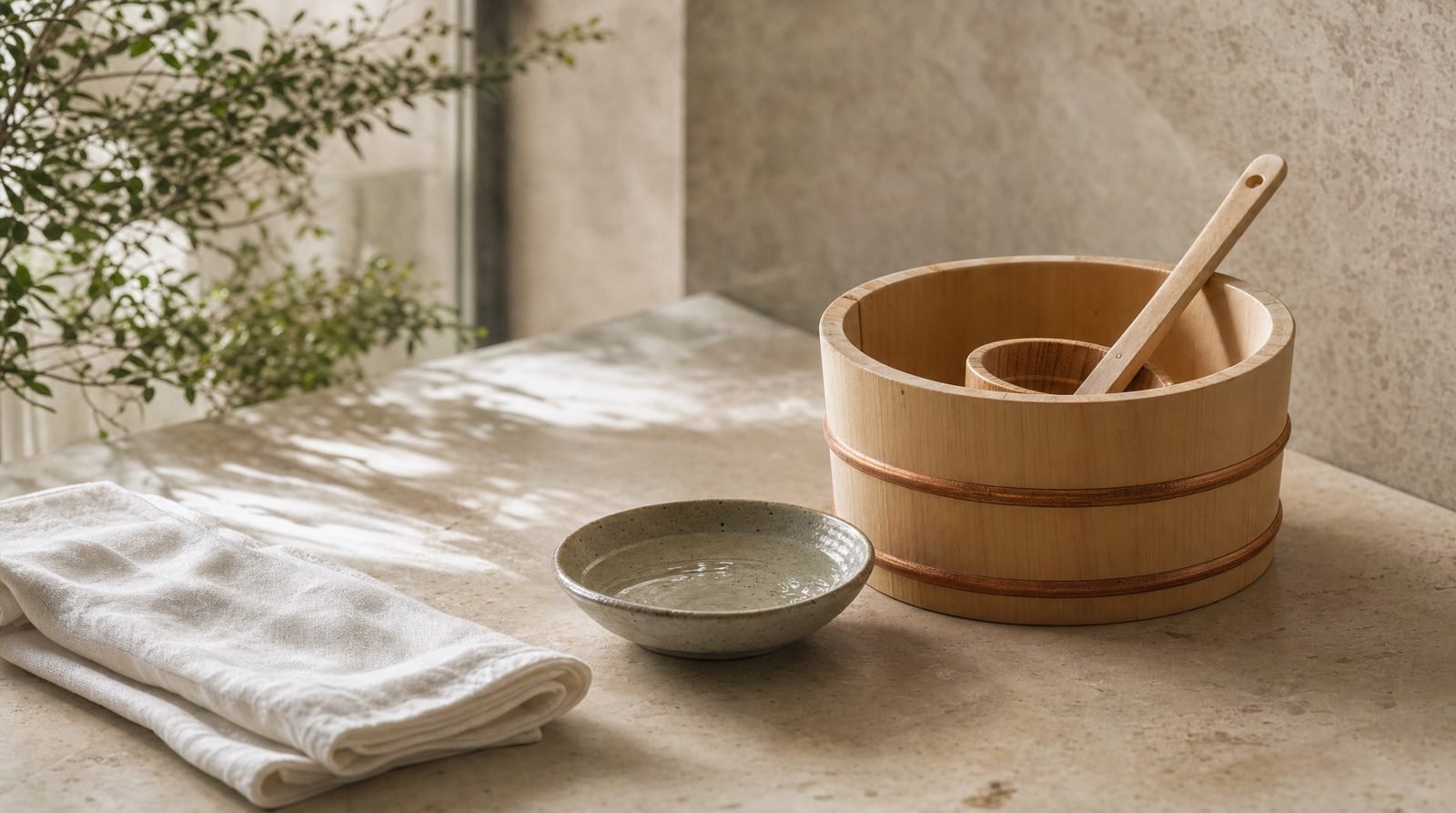
In Japanese, the word for everyday practice is not dramatic. It refers to the quiet things you do without thinking, the gestures that become part of who you are through repetition: brushing your hair, preparing tea, washing your face.
Skincare, in the Japanese tradition, belongs to this kind of practice. It is not a treatment. It is not a fix. It is a daily act of care, performed with attention, that gradually changes the relationship between a person and their skin. IKI was built on this idea, and it is worth spending some time with.
What does a Japanese skincare routine look like?
Simpler than most people expect. The traditional structure has four moves, morning and night:
- Cleanse gently. A soft foam or milk, worked with the fingertips for about a minute, rinsed with lukewarm water. At night, makeup and sunscreen come off first with an oil or balm; in the morning, water alone is common.
- Hydrate (the "lotion" step). In Japan, "lotion" means a watery hydrating layer pressed into damp skin with the palms, not a cream. Modern routines use a light hydrating serum or a gel-emulsion here.
- Moisturize. A cream or emulsion to seal the water in. Texture is chosen by season: lighter in summer, richer in winter.
- Protect. Sunscreen every morning, without exception. Japan has some of the best-tolerated sunscreens in the world for a reason: prevention is the whole strategy.
That is the routine. Two or three minutes, twice a day, with some portion of attention. What turns it into more than a routine is doing it every day: when tired, when traveling, when it seems to be working, especially then.
Korean vs Japanese skincare: what is the difference?
Both traditions prize hydration and gentleness, and the ingredients overlap. The difference is temperament. Korean skincare (K-beauty) is innovative and additive: many steps, new actives every season, fast visible results, playful textures. Japanese skincare (J-beauty) is reductive: fewer, refined products, formulas that change rarely, an emphasis on preventing damage rather than correcting it, and a tolerance for slow results.
Neither is better. For sensitive, reactive skin, the Japanese temperament is usually the safer fit, because every added step is a chance to irritate, and every changed product resets the clock on your skin's adaptation. IKI takes its ingredients from both traditions (Centella from the Korean side, rice and fermented ideas from the Japanese) and its philosophy from Japan.
What ritual actually means
The word ritual has been borrowed by the industry to sell complexity: rituals of seven, ten, twelve steps. That is not what ritual means in the tradition IKI draws from. A ritual, in its older sense, is a small repeated action performed with presence. The simpler it is, the more easily it becomes part of the day. What makes something a ritual is not its length but the attention brought to it. Washing your face can be a ritual. Applying moisturizer can be a ritual. The transformation is in the mindset, not the number of products.
Why repetition changes skin
The skin is a slow organ. It renews itself roughly every month, and that cycle lengthens with age. Any product, any routine, takes at least four to six weeks to show its true effect, often longer. This makes skincare uniquely unsuited to urgency: a product tried for a week cannot be judged. Ritual solves the problem quietly. When skincare becomes something you do without thinking, the timeline stops mattering. You are not waiting for results; you are continuing a practice. And then, almost without noticing, the results arrive.
Our own data says the same thing. In all five independent 30-day studies on IKI products, the average agreement score rose from day 1 to day 14, and again from day 14 to day 30 (for Iro, from 65% to 80% to 81%; for Kido, from 47% to 72% to 75%). Nothing changed except the days. You can see every number on the study results page.
Treating versus caring
The dominant language of modern skincare is treatment. We treat dark spots, fine lines, acne. The skin becomes a problem to be solved, and the relationship is adversarial. The Japanese approach suggests a different verb: not to treat, but to care for. The skin is not wrong; it is something you are responsible for, the way you are responsible for anything you live with every day. The relationship is ongoing, and it is patient.
How to begin a Japanese-style ritual
- Choose few products and commit for six weeks. For sensitive skin: a gentle cleanser (Kirei), a hydrating gel-emulsion pressed into damp skin (Iro), sunscreen. Add an antioxidant serum (Nihon) in the morning once the base is stable. The Everyday Morning Routine is exactly this.
- Same time, same order, every day, so it becomes automatic.
- Leave the phone in another room. Notice how the skin feels under your fingers: drier than yesterday, calmer, warmer. This noticing is how you begin to understand your skin.
- Press, don't rub. Palms on damp skin. Lukewarm water, never hot.
- Keep going when results are not visible yet. They are forming underneath.
Over time the practice gives back more than skin. The relationship with the mirror softens. The pressure to fix quiets down. The skin, receiving a consistent and gentle message, stops reacting as loudly. A ritual is just what happens when care becomes consistent.