Almost every anti-aging routine eventually lands on retinol, and for good reason: it is the most studied ingredient in cosmetic dermatology. It is also the step where sensitive skin most often falls apart. Peeling, stinging, a red patch around the nose that will not go away, and a barrier that takes weeks to recover.
Copper peptides have become the most talked-about alternative. This guide compares the two honestly: how each one works, what the research supports and what it does not, the downsides of each, and how to decide which one belongs in your night routine.
How retinol works, and why sensitive skin struggles with it
Retinol is a form of vitamin A. In the skin it is converted, in two steps, into retinoic acid, which binds to receptors in skin cells and changes how they behave. The results are well documented: faster cell turnover, more collagen, smoother texture and, over months, softer fine lines and more even pigment. Prescription retinoids such as tretinoin have decades of clinical trials behind them, and over-the-counter retinol works on the same pathway, more slowly.
The same mechanism is the problem. Speeding up turnover thins the outermost layer of the skin while it adapts, and the first weeks often bring what dermatologists call retinization: dryness, flaking, stinging and redness. Most people get through it in two to six weeks. On sensitive, rosacea-prone or barrier-damaged skin, many never do. Retinol also makes skin more vulnerable to sun damage during use and is not recommended during pregnancy.
What does copper peptide serum do?
Copper peptide, usually written GHK-Cu (INCI name Copper Tripeptide-1), is a very small protein fragment bound to a copper ion. Your body makes it: it was first isolated from human plasma in 1973, and levels fall steadily with age. In the skin it works as a signal rather than a stimulant:
- It signals repair. In laboratory studies on skin cells, GHK-Cu increases collagen, elastin and glycosaminoglycans, the materials that keep skin firm and elastic.
- It supports healing. It has been studied for wound healing since the 1980s, which is why it often appears in post-procedure care.
- It calms and protects. It has anti-inflammatory and antioxidant activity, so renewal does not come at the cost of irritation.
The key difference: copper peptides do not exfoliate and do not force cell turnover. That is why they do not cause retinization. Read the full profile in our copper peptide ingredient guide.
Copper peptides vs retinol: what the evidence actually says
This is where honesty matters, because the internet tends to oversell copper peptides.
- Retinol and retinoids have the strongest evidence of any topical anti-aging ingredient, from many independent, controlled trials over several decades, especially for wrinkles and sun damage.
- Copper peptides have strong and consistent cellular and wound-healing evidence. The human cosmetic studies are fewer, smaller and mostly sponsored by ingredient makers; 12-week trials of GHK-Cu creams report improvements in skin density, thickness, elasticity and fine lines, with very good tolerance.
So the fair summary is: retinol is more proven for deep wrinkles; copper peptides are well supported for repair, firmness and texture, and far better tolerated. For tolerant skin that wants maximum results, retinol remains the benchmark. For sensitive skin, the comparison that matters is a copper peptide used every night against a retinol abandoned after three weeks of peeling.
Side by side
- How it works: retinol speeds up turnover; copper peptide signals repair and collagen.
- Adjustment period: retinol usually 2–6 weeks of dryness and flaking; copper peptide none in most people.
- Sun sensitivity: retinol yes, use it at night with daily sunscreen; copper peptide does not photosensitize.
- Pregnancy: retinol is not recommended; for copper peptides there are no pregnancy studies, so check with your doctor.
- Frequency: retinol builds up from two or three nights a week; copper peptide can be used nightly from the start.
- Time to visible results: both take 8–12 weeks for firmness and fine lines.
What to use when you can't use retinol
If retinol has never worked for your skin, you have three well-tolerated routes, and they can be combined:
- Copper peptides for repair and firmness, at night.
- Bakuchiol, a plant-derived ingredient that in a 12-week comparison study gave results similar to low-strength retinol on wrinkles and pigmentation, with less scaling and stinging. See our bakuchiol guide.
- Antioxidants and sunscreen in the morning. Most visible aging is sun damage. A gentle vitamin C under daily SPF prevents more than any night serum repairs; our guide to vitamin C for sensitive skin explains which form to choose.
Supporting ingredients that make any of these work better: niacinamide and hyaluronic acid to keep the barrier steady, and resveratrol for additional antioxidant protection.
Izumi: how we built a renewal serum without retinol
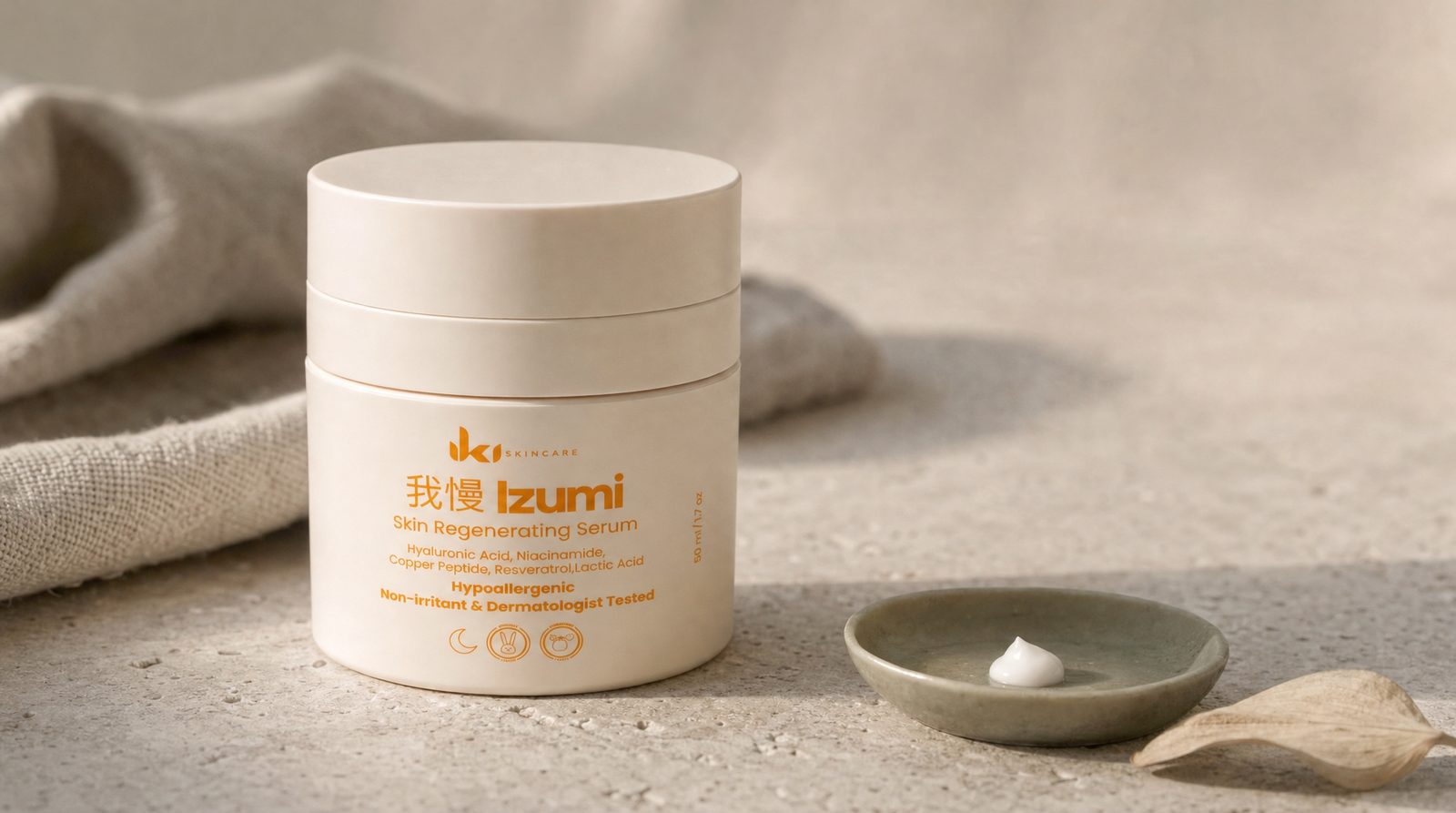
Our founder, Dr. Urbani, is a physician who lives with rosacea. Retinoids and strong acids are where she sees most anti-aging routines go wrong for reactive skin, so she formulated Izumi Skin Regenerating Serum around the route she uses on her own skin: copper tripeptide-1 with resveratrol, niacinamide, several forms of hyaluronic acid and a low level of lactic acid, in a creamy night serum. It contains no retinol and no fragrance.
In an independent 30-day perception study with 46 participants with sensitive skin, 93% said the serum is gentle on their skin, 87% said their skin appears more glowing and 76% noticed their skin appearing plumper, with no adverse events reported. You can read every question and answer on our study results page.
Should I use copper peptides every day?
Yes, most people can. Because copper peptides do not exfoliate, there is no need for the slow build-up that retinol requires. A simple night routine looks like this:
- Cleanse gently. A sulfate-free, pH-balanced cleanser such as Kirei.
- Copper peptide serum on clean, dry skin.
- Moisturizer to seal it in. Iro Emulsion Gel Moisturizer adds niacinamide, oat and Centella.
Give it at least 8 to 12 weeks before judging firmness and fine lines. Comfort and hydration usually improve within the first days. This is our three-step routine, applied to the night.
What should you not mix with copper peptides?
- Pure L-ascorbic acid in the same step. Its low pH can interfere with the copper complex. Use vitamin C in the morning and copper peptides at night. A gentle, near-neutral form such as sodium ascorbyl phosphate, the one in Nihon, fits easily into that split.
- Strong exfoliating acids in the same routine. High-strength AHA or BHA peels on the same night defeat the purpose of a gentle renewal step. If you exfoliate, do it on a different night, and rarely.
- Retinol on the same night, if your skin is sensitive. Alternating nights is possible, but for reactive skin we suggest copper peptides instead of retinol rather than on top of it.
Niacinamide, hyaluronic acid, ceramides, peptides of other types and resveratrol all layer well with copper peptides.
What are the downsides of copper peptides?
- Less evidence than retinoids. The research is promising but smaller, and mostly industry-funded. Anyone promising retinol-level wrinkle reduction is overselling.
- Slow, subtle results. Copper peptides improve firmness and texture gradually. They will not give you the visible "new skin" effect of a peel.
- Mixing restrictions. The vitamin C and strong-acid cautions above.
- Very high concentrations are not better. Some users of high-strength copper serums report temporary dullness or irritation. Products formulated at modest levels, inside a moisturizing base, avoid most of that.
- Color is not strength. Pure GHK-Cu is blue, but at cosmetic concentrations the tint is faint or invisible. A clear or white serum is not a weak one.
Can you use retinol if your skin is sensitive?
Sometimes, with care. Choose a low strength, buffer it inside a calming formula, apply it two or three nights a week at first, and use sunscreen every morning. Our Kido Brightening Serum is an example of that approach: it pairs retinol with bakuchiol, kojic acid and alpha arbutin for dark spots, with Centella asiatica to keep skin calm. In its 30-day study with 45 participants with sensitive skin, 89% said it is gentle on their skin. It is a night product, and like every retinol product it is not for use during pregnancy.
If you want both, keep them on separate nights: Kido for tone and dark spots, Izumi for firmness and repair. Start one, wait two to three weeks, then add the other.
The bottom line
Retinol is the most proven anti-aging ingredient, and if your skin tolerates it, it earns its place. If your skin does not, you are not out of options. Copper peptides offer real, gentler renewal: slower and less dramatic, but something you can use every night without paying for it with your barrier. For sensitive skin, the best anti-aging active is the one you can keep using.