Vitamin C has one of the strongest track records in skincare. It neutralizes free radicals from UV and pollution, supports collagen, and fades dullness and uneven tone over time. It is also one of the products people with sensitive skin most often give up on: the serum stings, the cheeks flush, the bottle turns orange before it is finished, and the conclusion is "vitamin C is not for me."
In most cases the vitamin is not the problem. The form is. This guide explains why classic vitamin C irritates reactive skin, what the gentler derivatives are, what you give up by choosing one, and how to add it to a sensitive-skin routine without undoing a calm barrier.
Is vitamin C serum good for sensitive skin?
Vitamin C itself is well tolerated by skin; your body already uses it everywhere. The difficulty is getting it into the skin in a form that is stable and that penetrates. The classic answer, L-ascorbic acid, solves penetration by being formulated at a very low pH, and that is the part sensitive skin objects to.
So the honest answer is: vitamin C is good for sensitive skin, a pH-3 serum often is not. If you have rosacea, a damaged barrier, eczema-prone skin or skin that reacts to most actives, start with a derivative, apply it in the morning under moisturizer and sunscreen, and build up slowly.
Why classic vitamin C stings
L-ascorbic acid (LAA) is the pure, biologically active vitamin. It has the most research behind it, and it has three practical problems:
- It needs acidity. To cross the outer layer of the skin it has to be in its uncharged form, which only happens at a pH of roughly 3.0 to 3.5. Healthy skin sits around 4.7 to 5.5. Putting a pH-3 liquid on a weakened barrier is what produces the tingle, the heat and the flush.
- It oxidizes quickly. Light, air and warmth break it down. The serum turns yellow, then orange, then brown. Oxidized vitamin C is not just less effective; its breakdown products can add to irritation.
- High strengths are the norm. Many LAA serums are sold at 15% to 20%. More is not proportionally better: absorption plateaus around 20%, while irritation keeps rising.
For tolerant skin, a well-made LAA serum is excellent. For reactive skin it is often the product that tips a fragile barrier over the edge. If that sounds familiar, our guide to repairing a damaged skin barrier is the place to start before any active.
What is sodium ascorbyl phosphate?
Sodium ascorbyl phosphate (SAP) is vitamin C with a phosphate group and sodium attached. That small change does two things: it protects the molecule from oxidation, and it lets the formula sit at a skin-friendly pH of about 6 to 7. Once SAP is in the skin, natural enzymes called phosphatases remove the phosphate and release ascorbic acid where it is needed.
It is water-soluble, it does not need an acidic base, and it stays stable in the bottle far longer than LAA. It also has its own line of clinical evidence: at 1% to 5%, SAP reduced acne lesions in clinical trials, which makes it one of the few vitamin C forms suited to sensitive and acne-prone skin at the same time. Read the full profile in our sodium ascorbyl phosphate ingredient guide.
The honest trade-off
SAP is less potent per gram than L-ascorbic acid, because not all of it is converted, and its brightening effect is slower. If your skin tolerates a pH-3 serum and your only goal is the fastest possible change in dark spots, LAA may act faster. For reactive skin, though, the comparison that matters is not SAP versus LAA on paper. It is SAP used every morning versus an LAA serum abandoned after two weeks.
Which vitamin C serum is best for very sensitive skin?
There is no single best product, but there is a clear checklist. Look for:
- A stable derivative. Sodium ascorbyl phosphate is the best-known gentle option. Magnesium ascorbyl phosphate (MAP), ascorbyl glucoside and tetrahexyldecyl ascorbate are other derivatives with good tolerance; they differ in stability, solubility and how much evidence stands behind them.
- Antioxidant partners. Vitamin E (tocopherol) and ferulic acid help stabilize vitamin C and extend its antioxidant effect. This trio is the most studied antioxidant combination in skincare.
- No added fragrance. Fragrance and essential oils are among the most common contact allergens. An antioxidant serum has no reason to contain them.
- Opaque, air-limiting packaging. Even stable forms last longer away from light and air.
- A modest promise. "Brighter in 3 days" on sensitive skin usually means a strong acid. Realistic brightening with any vitamin C takes weeks.
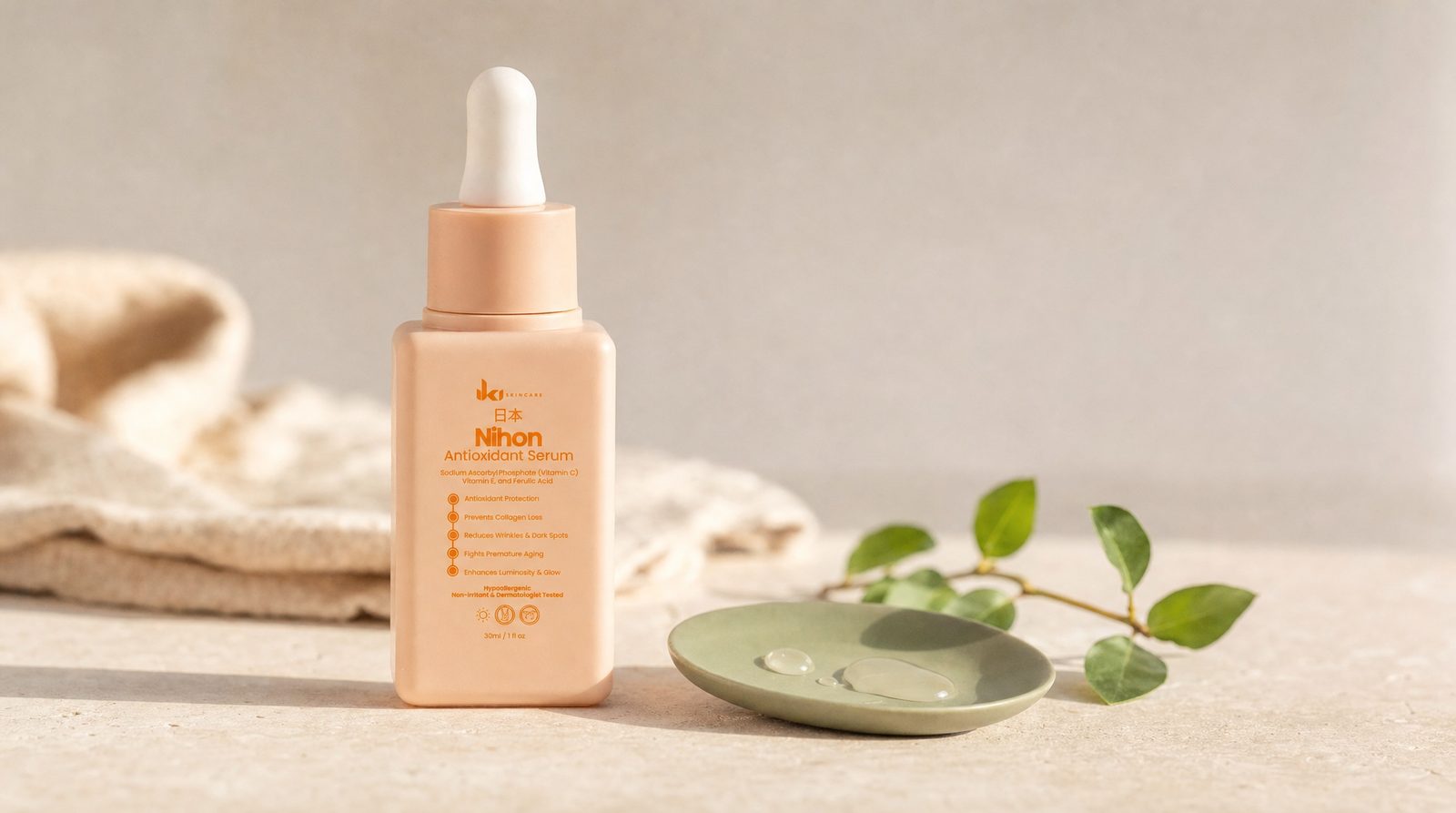
This is the brief our founder, Dr. Urbani, a physician who lives with rosacea, worked from for Nihon Antioxidant Serum: sodium ascorbyl phosphate with vitamin E and ferulic acid, fragrance-free, made for the morning step under moisturizer and sunscreen. In her practice, classic vitamin C is one of the most common triggers she sees in reactive skin; Nihon exists so that sensitive skin can have the antioxidant step without the sting.
Which is better for sensitive skin, niacinamide or vitamin C?
They do different jobs, so the useful question is which one you need first.
- Niacinamide is the barrier ingredient. It increases ceramide production, reduces water loss and calms redness. If your skin is currently stinging, tight or flaking, niacinamide comes first.
- Vitamin C is the protection and brightening ingredient. It neutralizes the free radicals that UV and pollution create and, over time, evens out tone. It is most useful once the barrier is calm.
You do not have to choose. The old rule to keep vitamin C and niacinamide apart came from early studies with unstable, low-pH L-ascorbic acid. With a near-neutral derivative like SAP, they layer without issues. In our morning routine, Nihon goes on first and Iro Emulsion Gel Moisturizer, which contains niacinamide with colloidal oat, Centella asiatica and hyaluronic acid, goes on top. In Iro's 30-day study with 49 participants with sensitive skin, 100% said it feels gentle and 90% said their skin felt calmed and soothed.
Can I use a vitamin C serum daily?
Yes, and daily is how antioxidants work best: they are used up as they neutralize free radicals, so steady, everyday application matters more than a high dose once in a while. For sensitive skin, a gentle start looks like this:
- Patch test first. Apply a small amount along the jawline for three evenings. No redness or itching, move on.
- Weeks 1–2: three or four mornings a week. If your barrier has been compromised recently, this gives it time to adjust.
- Week 3 onward: every morning. Two or three drops are enough for face and neck.
- Watch, do not push. Mild tightness that fades is fine. Stinging that lasts or redness the next day means step back to every other morning.
Expect the first visible changes, a slightly brighter, more even look, after about four to eight weeks of consistent use. The protective effect is invisible but starts with the first application.
When to apply vitamin C (and what to pair it with)
Morning is the right time. Vitamin C and sunscreen work together: sunscreen blocks most UV, and antioxidants neutralize part of the damage that gets through. The order is simple:
- Cleanse gently, or just rinse with lukewarm water in the morning. Kirei Calming Foam Cleanser is sulfate-free and pH-balanced; in its 30-day study with 48 participants, 92% said it did not cause irritation.
- Vitamin C serum on dry or slightly damp skin.
- Moisturizer.
- Sunscreen, every day, as the last step.
This is exactly the three-step routine we recommend: cleanse, protect, hydrate, then SPF. At night, leave vitamin C out and use your renewal step there instead. For sensitive skin, copper peptides (Izumi) are a gentle option; if you use a retinol serum such as Kido, keep it at night and note that retinol is not recommended during pregnancy.
Combinations to avoid on sensitive skin
- Vitamin C plus exfoliating acids in the same routine. Stacking AHAs or BHAs on top of any vitamin C is the fastest way back to a damaged barrier. Use acids, if at all, on separate nights.
- Two vitamin C products at once. A serum plus a vitamin C moisturizer plus a vitamin C toner adds irritation, not results.
- Starting vitamin C and retinol in the same week. Introduce one active at a time, with two to three weeks between them, so you know what your skin is reacting to.
Is vitamin C serum good for the neck?
Yes. The neck gets the same UV exposure as the face and is often skipped by sunscreen. Its skin is thinner, so a gentle derivative is a particularly good fit there. Apply what is left on your fingertips down the neck, then follow with moisturizer and SPF.
What percentage of vitamin C should you look for?
For L-ascorbic acid, studies point to 10% to 20%, with little gained above 20%. For sensitive skin, the percentage on a derivative label matters less than the form and the formula around it: derivatives are dosed differently, and a well-tolerated serum used daily will do more than a higher number you can only use twice a week. Treat very high strengths and very low pH as warning signs rather than selling points.
The bottom line
Sensitive skin does not have to skip vitamin C. It needs a form that does not depend on acidity, a formula without fragrance, and a slow start. Sodium ascorbyl phosphate with vitamin E and ferulic acid checks those boxes; the trade-off is patience, not comfort.
IKI was built for sensitive skin, and we have tested our products on it in independent 30-day perception studies with 232 participants and zero adverse events reported. You can read every question and every percentage on our study results page, and see how each ingredient fits on our ingredients page.