Bakuchiol arrived in skincare with a promise that sounds almost too convenient: the results of retinol, without the peeling, the stinging or the sun sensitivity. Today it is on the label of hundreds of serums marketed as the "natural retinol."
Some of that promise holds up, and some of it is marketing. This guide walks through what bakuchiol is, what the research really shows, how it compares with retinol side by side, and how to decide which one belongs in your routine if your skin is sensitive.
What does bakuchiol serum do for your skin?
Bakuchiol is a compound extracted from the seeds of Psoralea corylifolia, a plant known as babchi that has a long history in Ayurvedic and traditional Chinese medicine. Chemically it has nothing in common with vitamin A. What caught researchers' attention is that, in laboratory work, it changes the activity of many of the same genes that retinol does, including those involved in collagen production.
On the skin, that translates into four things:
- Smoother texture and softer fine lines over several weeks of regular use.
- More even tone, with a reduced appearance of sun spots and hyperpigmentation.
- Antioxidant and anti-inflammatory activity, so renewal comes with less irritation, not more.
- No added sun sensitivity, so it can be used in the morning under sunscreen as well as at night.
For a deeper profile of the ingredient, read our bakuchiol ingredient guide.
Bakuchiol vs retinol: what the evidence actually says
Almost every claim that bakuchiol "works like retinol" goes back to a single study, so it is worth knowing exactly what it found.
In 2018, the British Journal of Dermatology published a 12-week randomized, double-blind trial with 44 participants. One group applied 0.5% bakuchiol cream twice a day; the other applied 0.5% retinol cream once a day. Both groups saw a similar, significant reduction in wrinkle surface area and hyperpigmentation, with no statistically meaningful difference between them. The retinol group reported more facial scaling and stinging.
That is a well-designed trial, and its result is encouraging. Its limits matter too:
- It is one study, with a small group, run for three months and supported by an ingredient supplier.
- It compared bakuchiol with over-the-counter retinol, not with prescription retinoids such as tretinoin, which have the strongest evidence of all.
- Retinol has decades of independent research behind it, including long-term studies on sun-damaged skin. Bakuchiol does not yet.
The honest summary: bakuchiol is the only "retinol alternative" with a head-to-head trial behind it, and in that trial it held its own. "Comparable in the short term, much better tolerated" is fair. "Just as proven as retinol" is not.
Side by side
- What it is: retinol is a form of vitamin A; bakuchiol is a plant compound that is not a retinoid.
- How it works: retinol converts to retinoic acid and speeds up cell turnover; bakuchiol acts on similar pathways without that conversion.
- Adjustment period: retinol usually brings 2 to 6 weeks of dryness and flaking; bakuchiol typically none.
- Sun sensitivity: retinol yes, so use it at night; bakuchiol no, so morning or night.
- Pregnancy: retinol is not recommended; bakuchiol has no pregnancy safety data, so ask your doctor.
- Evidence: retinol decades and many trials; bakuchiol one strong trial plus smaller studies.
- Time to visible results: both around 8 to 12 weeks for fine lines and tone.
Which is better, retinol or bakuchiol?
It depends less on the ingredient than on your skin.
- Choose retinol if your skin has tolerated it before, your main goal is deeper wrinkles or long-standing sun damage, and you are willing to build up slowly and wear sunscreen every day.
- Choose bakuchiol if retinol has ever made your skin peel, burn or flush, if you have rosacea-prone or barrier-damaged skin, or if you want a renewal step you can use every day without an adjustment period.
The most effective active is the one you can keep using. Twelve weeks of a gentle ingredient will do more for your skin than three weeks of retinol followed by a month of repairing your barrier. If your skin is in that recovery phase right now, start with our guide on how to repair a damaged skin barrier before adding any active.
What to use when you can't use retinol
Bakuchiol is one option, not the only one. If retinol is off the table for you, these are the well-tolerated routes, and they combine well:
- Bakuchiol for fine lines and tone, morning or night.
- Copper peptides for repair and firmness at night. They signal the skin to make more collagen without forcing turnover; we compare them in copper peptides vs retinol.
- Gentle brighteners such as alpha arbutin and kojic acid if dark spots are your main concern.
- A gentle vitamin C and sunscreen every morning. Most visible aging comes from the sun, and prevention outperforms any night serum. See vitamin C for sensitive skin.
A few related questions come up often. In Korean skincare, the common gentle alternatives to retinoids are bakuchiol, peptides, adenosine and Centella asiatica. And you may have seen something described as "11 times faster than retinol": that usually refers to retinal (retinaldehyde), which is itself a vitamin A form, one conversion step closer to retinoic acid. It is not a retinol alternative for skin that cannot tolerate retinoids, and the "11 times" figure comes from laboratory research, not from head-to-head studies in people.
Is bakuchiol a pregnancy-safe retinol alternative?
This is one of the most searched questions about bakuchiol, and the honest answer is: we do not know for certain. Retinoids are not recommended during pregnancy or breastfeeding. Bakuchiol is not a retinoid and is generally considered lower risk, but there are no studies of its safety in pregnancy. Be cautious with any product that labels it "pregnancy safe" as a fact. If you are pregnant or breastfeeding, ask your doctor before using it, and check the full ingredient list: some "bakuchiol serums" also contain retinol or retinyl esters.
What should you not mix with bakuchiol?
Bakuchiol is one of the easier actives to combine. It layers well with niacinamide, hyaluronic acid, ceramides, Centella, peptides and vitamin C. A few practical cautions for sensitive skin:
- Strong exfoliating acids in the same routine. Bakuchiol itself is not the problem; stacking several actives at once is. Keep high-strength AHA or BHA exfoliation to a separate night, and use it rarely.
- Introducing several new products at the same time. If something irritates, you will not know what. Add one active, wait two to three weeks, then add the next.
- Retinol, if your skin is reactive. The two can be used together, and some formulas combine them so the gentler ingredient supports the stronger one. If your skin is very sensitive, start with bakuchiol alone.
How to choose a bakuchiol serum
- Look for the concentration. The trial used 0.5%. Brands that disclose their percentage are easier to judge; a product that lists bakuchiol at the very end of the ingredient list likely contains very little.
- Check for retinoids. If you chose bakuchiol to avoid retinol, read the full INCI for retinol, retinal or retinyl palmitate.
- Skip the fragrance. A gentle active inside a fragranced or essential-oil-heavy base defeats the purpose for reactive skin.
- Prefer a calm base. Ingredients such as Centella asiatica, niacinamide and hyaluronic acid make any renewal step easier to tolerate.
How IKI approaches renewal for sensitive skin
Our founder, Dr. Urbani, is a physician who lives with rosacea. Her approach to renewal is the one in this guide: choose actives your skin can keep using, and surround them with calming ingredients. That is why IKI has two different routes.
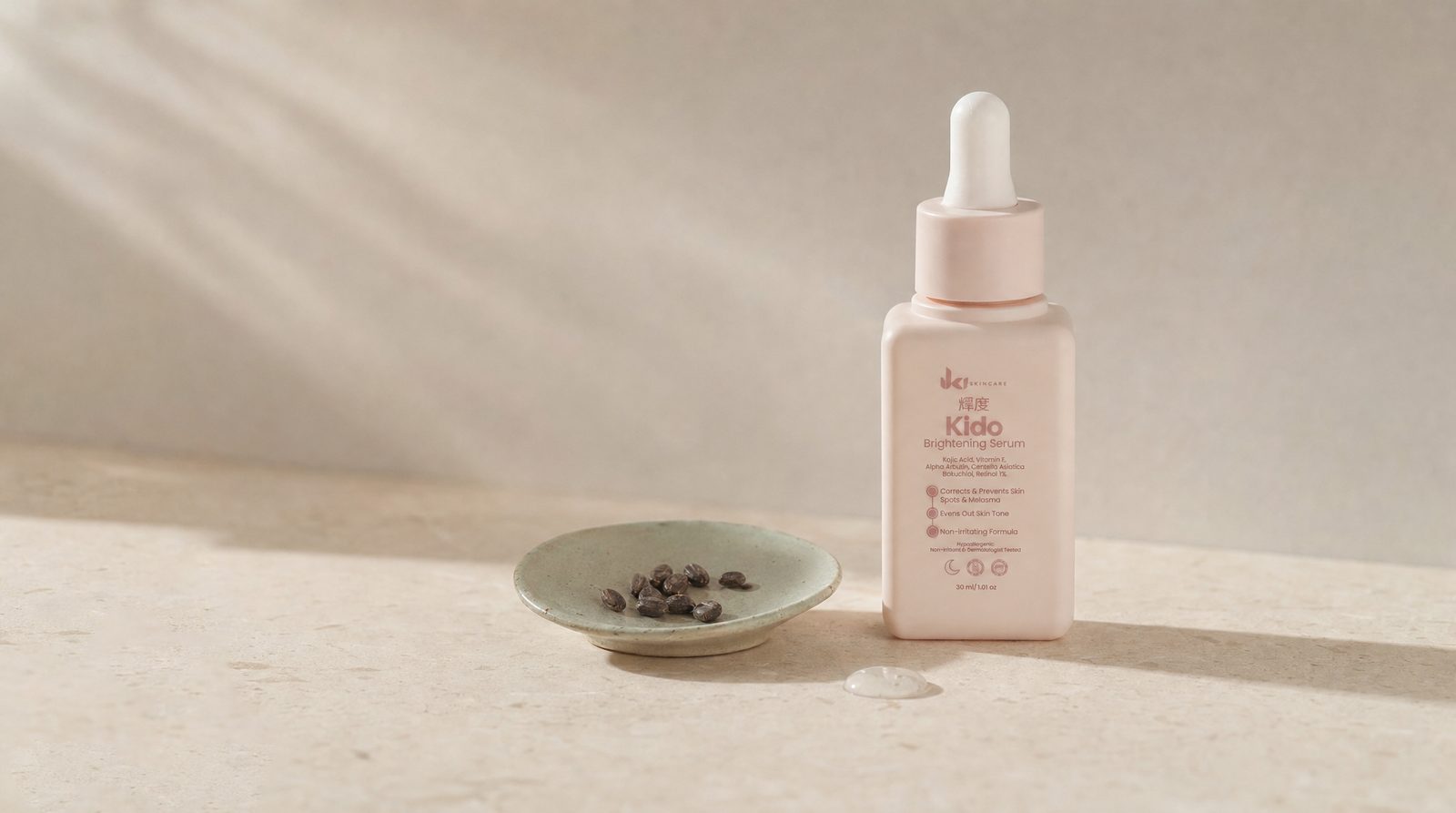
Kido Brightening Serum is our serum for dark spots and uneven tone. It pairs retinol with kojic acid dipalmitate and alpha arbutin, inside a fragrance-free base with Centella asiatica and hyaluronic acid. In an independent 30-day perception study with 45 participants with sensitive skin, 89% said it is gentle on their skin, 87% said their skin has a more luminous glow and 73% said their skin tone appears more even. Because it contains retinol, Kido is a night serum: start with three nights a week, wear sunscreen every morning, and do not use it during pregnancy or breastfeeding.
Izumi Skin Regenerating Serum is our retinol-free route: copper peptides with niacinamide and hyaluronic acid, fragrance-free. In its 30-day study with 46 participants with sensitive skin, 93% said it is gentle on their skin and 87% said their skin appears more glowing. Both studies reported no adverse events. You can read every question and answer on our study results page.
Whichever you choose, keep the rest of the routine simple: a gentle cleanser such as Kirei, your serum, and a moisturizer such as Iro. That is our three-step routine.
The bottom line
Bakuchiol is not a miracle and not a myth. It is a well-tolerated plant ingredient with one strong trial showing results comparable to over-the-counter retinol over 12 weeks, and far less irritation. Retinol remains the more proven ingredient for skin that tolerates it. If yours does not, bakuchiol is a sensible, evidence-based place to start, as long as you give it the same patience: daily use, sunscreen, and at least two to three months.